Shock Absorber Replacement
Worn shocks let the JK porpoise on freeway expansion joints, wallow in corners, and bounce after bumps; replacing all four is a two-hour driveway job that completely changes how the truck feels.
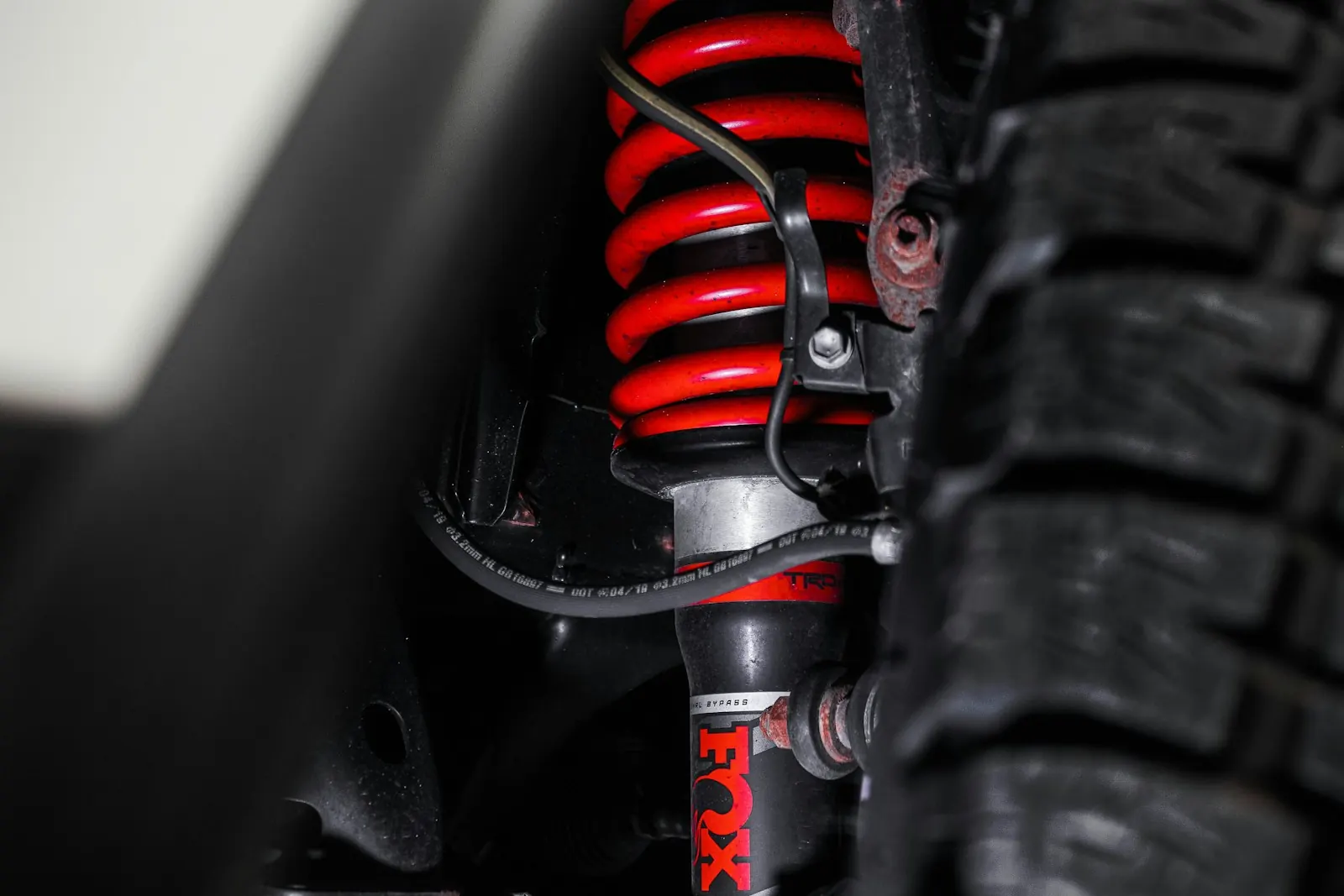
Shocks wear out by 60,000-80,000 miles even on stock JKs, and lifted JKs eat them faster because the stock shock travel is wrong for the new ride height. Symptoms of dead shocks: bounce more than one cycle after a speed bump, front-end dive under braking, tail squat under acceleration, and a "floaty" feel on the highway. Pull a shock and shake it — if there's any free play in either direction without resistance, it's done.
For a stock-height JK, replacement OE-spec shocks (Bilstein B6 or Mopar) run $50-$80 each and are fine. For a 2-3.5" lift, the Bilstein 5100 (front 24-146708, rear 24-146715) is the value benchmark at roughly $440 for the set — monotube design, zinc-plated, with the right extended length for a typical mid-height JK. Fox 2.0 IFPs ($90-100 each) ride better over washboard at the cost of more dust seal wear. Old Man Emu Nitrochargers ride softer than Bilsteins, better for overlanders carrying weight.
Skip "lifetime warranty" parts-store shocks. They're rebadged budget twin-tubes that fade after a hot trail run and feel mushy when new.
A shock controls spring motion by forcing oil through a valved piston — that's the entire job. As the oil heats up on a long, rough trail run or repeated freeway expansion-joint impacts, its viscosity drops and it can aerate (mix with air inside the shock body), and a thinner, aerated fluid flows through the valve with less resistance. That's fade: the shock physically can't generate the damping force it did when cold, so the truck starts to feel loose and bouncy exactly when you need control most. Monotube shocks (Bilstein 5100, Fox 2.0 IFP) resist fade better than twin-tube designs because the single larger oil chamber dissipates heat faster and the design tolerates a gas-charge that suppresses aeration. Remote-reservoir shocks (Fox 2.0 Performance Series Remote Reservoir, roughly $900/pair) push oil volume out to an external canister, multiplying the oil available to absorb heat — the right upgrade for a truck that sees sustained high-speed desert running or repeated long descents where a standard monotube shock still fades.
Install is bolt-in. The only annoying part is the front lower shock bolt, which often seizes — soak it in penetrating oil the night before. The shock shaft will spin while you tighten the upper nut; use an Allen key socket on the shaft top to hold it steady.
Torque specs after install: front upper 20 ft-lb, front lower 56 ft-lb, rear upper 37 ft-lb, rear lower 65 ft-lb. Bounce-test each corner before lowering — a properly seated shock returns to ride height with one cycle, not two.
Shock length is the detail that gets people into trouble. A shock too short for the lift will top out at full droop — the internal bump stop inside the shock hits before the coil spring runs out of travel, and repeated topping-out will blow the shock's internal seals within a season. A shock too long bottoms out early, transferring impact straight into the frame mounts. Bilstein and Fox both publish specific part numbers keyed to lift height ranges (the 24-146708/24-146715 pair above is specifically for 1.5-3" of lift) — buy by your actual measured lift height, not by kit name, since a "2.5-inch lift kit" from one brand doesn't always land at the same ride height as another's.
Steps
- Park on level ground, chock the wheels you aren't lifting, and break loose the lug nuts before jacking.
- Jack one corner and set on a stand. Remove the wheel for working clearance.
- Front: remove the upper nut (hold the shaft with an Allen key), then the lower bolt at the axle bracket. Compress the old shock and pull down/out.
- Compare new and old shock length — they should match when fully extended.
- Install upper end first, then lower. Hand-thread both before torquing.
- Torque: front upper 20 ft-lb, front lower 56 ft-lb, rear upper 37 ft-lb, rear lower 65 ft-lb.
- Repeat at remaining three corners.
- Lower the vehicle, re-torque lug nuts to 95 ft-lb, and bounce-test each corner.
Why it works
- Restores ride quality and handling
- Bolt-in, no alignment needed
- Bilstein 5100 set is under $500 for all four
- Improves towing and load stability
- Remote-reservoir upgrade solves fade for high-speed or sustained trail running
Trade-offs
- Lower bolts often seize and require penetrating oil or heat
- Wrong-length shocks for your lift height will top out or bottom out
- Cheap shocks fade fast — buy once, cry once
- Remote-reservoir kits roughly triple the cost of a mid-tier set and need reservoir mounting brackets
Tools required
- floor jack
- jack stands
- metric sockets
- torque wrench
- Allen key for shock shafts
Parts
| Part | Vendor | Est. price |
|---|---|---|
| Bilstein 5100 front shocks (1.5-3" lift) | Bilstein | ~$110 |
| Bilstein 5100 rear shocks (2" lift) | Bilstein | ~$110 |
| Fox 2.0 Performance Series IFP shocks | Fox | ~$360 |
| Old Man Emu Nitrocharger Sport | ARB / OME | ~$280 |
| Fox 2.0 Performance Series Remote Reservoir | Fox | ~$900 |
Sources
- JK Bilstein 5100 install (ExtremeTerrain)
- JK Suspension Torque Specs
- Bilstein 5100 Shock Set 2007-2018 JK
Related
- JK Lift Kit Types — Spacers vs. Short Arm vs. Long Arm
- Coil Spring Replacement
- All Jeep Wrangler JK guides & tools
- Browse the full DIY database
Written and maintained by an AZ wheeler and driveway wrencher. How we source guides. Always cross-reference your factory service manual — modifications affect vehicle safety and warranty. Work at your own risk.