Rock Sliders and Rocker Guards
Rock sliders protect the most vulnerable section of the JK's body from rock strikes that would otherwise crumple the rocker panels — on a JK that sees real trails, they're as important as a front bumper.
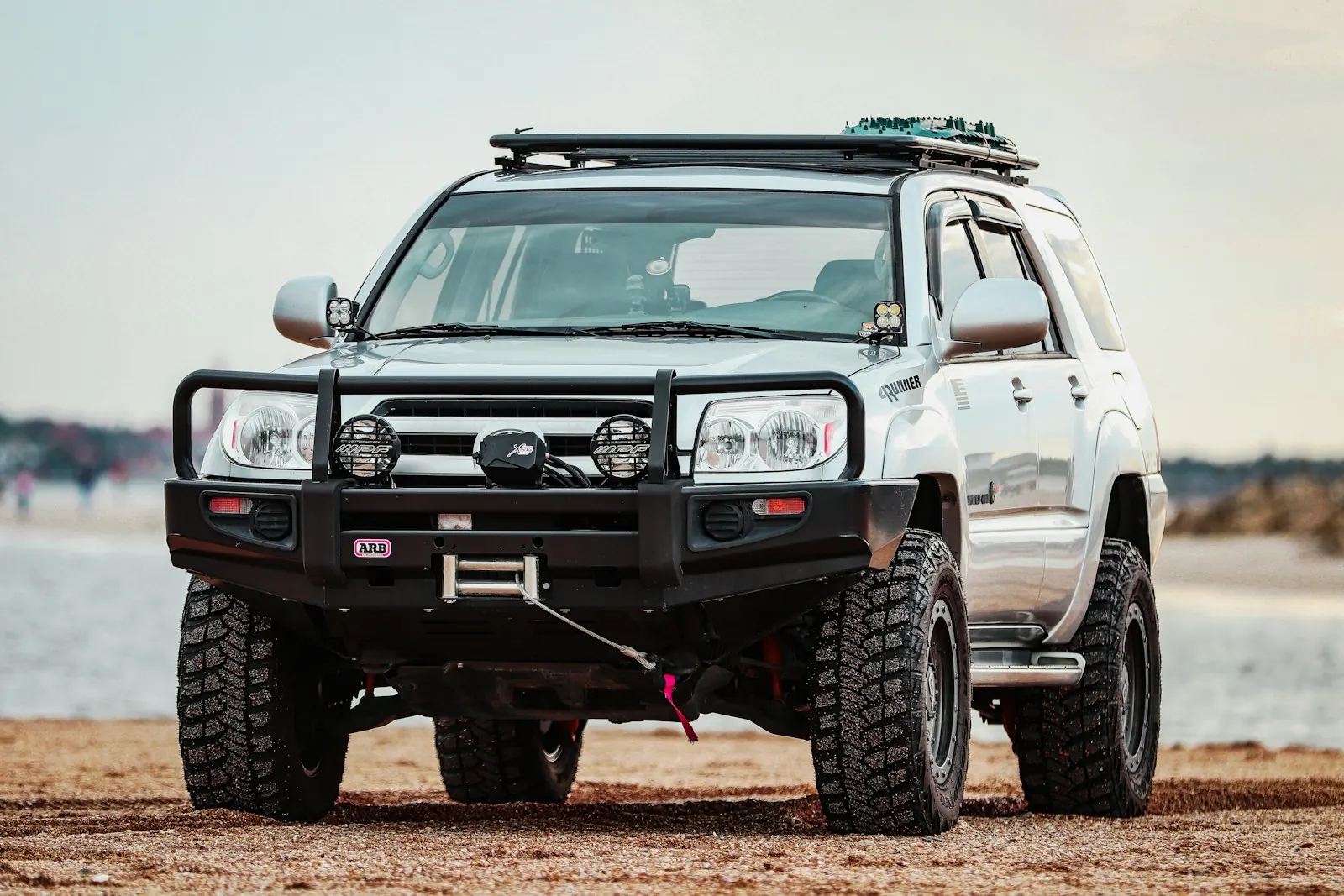
The JK's rocker panels are the lowest point of the body tub and the first thing to contact rocks on shelf trails or ledges. Factory rockers are thin sheet metal — one solid hit at trail speed will dent, tear, or fold them. Rock sliders bolt to the body and frame, extending outward to intercept rock contact before it reaches the rocker. A quality slider transfers the impact energy to structure rather than sheet metal, keeping your body straight and your sill intact. The Smittybilt SRC is the volume seller at this price point — it's bolt-on, fits the 4-door Unlimited cleanly, and at $449 it's the right call if you're building a trail rig on a budget. Rock Hard 4x4's tube sliders at $379 are the lowest-cost option that still uses proper 1.75" DOM tube construction and mounts with the right number of contact points.
The distinction that matters most when comparing sliders is tube-style versus plated-skid-style. Tube sliders use round DOM tubing to create a contact surface that rolls over rocks and deflects blows. Plated sliders use flat steel panels that offer more coverage and better structural rigidity but can catch on ledges more aggressively. Poison Spyder and LOD sliders sit at the quality end of this range — both are built from heavier-gauge steel with additional gussets at the mounts. LOD's Destroyer series can also be ordered with a side step, but this is worth addressing directly: steps on rock sliders are a bad idea for a rig that actually wheels. A step creates an overhang that catches rocks and provides a prying point; if you want step functionality, add it separately on a rig that stays on forest roads.
JK sliders come in two mounting philosophies, and the difference decides what you're allowed to do with them. Most bolt-on sliders fasten to the body: the pinch seam and the lower rocker structure. That protects the sheet metal from scrapes and moderate hits, and the load path ends in the tub. Frame-tied designs add outriggers that drop to the frame rail, so a hard impact bypasses the body entirely — this is what you want on a rig that sets the slider down on rock and pivots on it. The difference shows up sharpest at the jack: a Hi-Lift under a body-mounted slider lifts the tub on its body mounts and can oil-can the rocker or tweak door gaps, while a frame-tied slider is a legitimate lift and recovery point. If jacking or winching off the sliders is anywhere in your plan, buy frame-tied and confirm the manufacturer rates it for that use. The same logic applies to skid plates — armor is a system, and the load path matters as much as the steel.
The 4-door Unlimited's 116" wheelbase means a much longer slider span, more mid-span flex under load, and a worse breakover angle that puts the rocker into rocks more often — which is why slider quality matters more on the JKU than on the 2-door. Look for mid-span mounting points on 4-door sliders, not only ends. Sliders are body-specific and not interchangeable between the two, so order for your wheelbase. If you're running larger tires, check the slider's outboard reach against tire clearance at full stuff — a wide slider and a 37" tire can meet at full flex on some combinations. A body lift also shifts a body-mounted slider up relative to the frame, opening a gap below it that a rock will find.
For tube sliders, the floor is 1.75" x 0.120-wall DOM tubing — HREW tube shows up in bargain listings and dents where DOM deflects. For plated designs, 3/16" steel is the working minimum. Powder coat chips wherever the slider touches rock; plan on an annual touch-up with rust converter and paint, and check that tube designs have weep holes so the tube interior doesn't rust from trapped condensation. Weight is real: 35–65 lbs per side for plated steel, and it rides on the springs, so factor it into spring-rate decisions on a build that's already carrying bumpers and a winch.
Installation is bolt-on for all options listed, but the term "bolt-on" covers a range of difficulty. Rock Hard and Smittybilt sliders use factory holes and are genuinely straightforward. Poison Spyder and LOD sliders often require drilling into the rocker seam or lower body — follow the template precisely and use the included hardware. Coat all cut or drilled edges with rust inhibitor before final assembly, especially in climates that see salt or mud. On 2007–2011 JKs, inspect the factory rocker mounting seam for rust before slider installation — installing sliders over corroded sheet metal creates a hidden moisture trap.
Steps
- Inspect factory rocker panels for rust or damage before proceeding.
- Clean the mounting area on the lower rocker and frame rail with a wire brush.
- Dry-fit the slider to confirm alignment and identify any drilling locations.
- Drill any required new mounting holes per the template supplied with the kit.
- Coat all raw metal edges (drilled holes, cut surfaces) with rust-inhibiting primer.
- Install the slider with all supplied hardware — do not fully torque until all bolts are started.
- Torque all bolts to spec once slider is fully aligned.
- Verify clearance between slider and tire at full suspension droop and full stuff.
- On 4-door (Unlimited) JKs, confirm the slider clears the rear door threshold when opening.
Why it works
- Prevents costly rocker panel damage on shelf trails and ledge crossings
- Bolt-on installation does not require frame welding on any listed option
- Frame-tied designs double as rated jack and pivot points
- Heavy-gauge options (Poison Spyder, LOD) add meaningful structural rigidity to the lower body
Trade-offs
- Steps on rock sliders create ledge-catching hazards — avoid on purpose-built trail rigs
- Body-mounted sliders are not safe Hi-Lift jack points — only frame-tied designs carry that load
- Drilling is required for some kits — irreversible body modification
- Adds 35–65 lbs of sprung weight per side depending on construction
Tools required
- floor jack
- jack stands
- socket set
- torque wrench
- drill
- wire brush
Parts
| Part | Vendor | Est. price |
|---|---|---|
| Smittybilt SRC Rock Sliders (JK 4-door) | Smittybilt | ~$449 |
| Poison Spyder Brawler Tube Sliders (JK) | Poison Spyder | ~$699 |
| LOD Offroad Destroyer Rock Sliders (JK) | LOD Offroad | ~$599 |
| Rock Hard 4x4 Tube Rock Sliders (JK 4-door) | Rock Hard 4x4 | ~$379 |
Sources
Related
- Skid Plate Kit — Engine, Transfer Case, and Fuel Tank Protection
- Budget Steel Front Bumper (≤$600)
- All Jeep Wrangler JK guides & tools
- Browse the full DIY database
Written and maintained by an AZ wheeler and driveway wrencher. How we source guides. Always cross-reference your factory service manual — modifications affect vehicle safety and warranty. Work at your own risk.