Raptor Axle Health: Front CV Half-Shafts and the Rear 9.75
The Raptor has independent front suspension, so the front "axles" are CV half-shafts, not a solid axle — they fail at the boots first, not the joints. The rear is a Ford 9.75 solid axle that wants a gear oil change every 30,000 miles of hard use, sooner if you wade water. Inspect the front CV boots at every tire rotation; service the rear diff on a schedule.
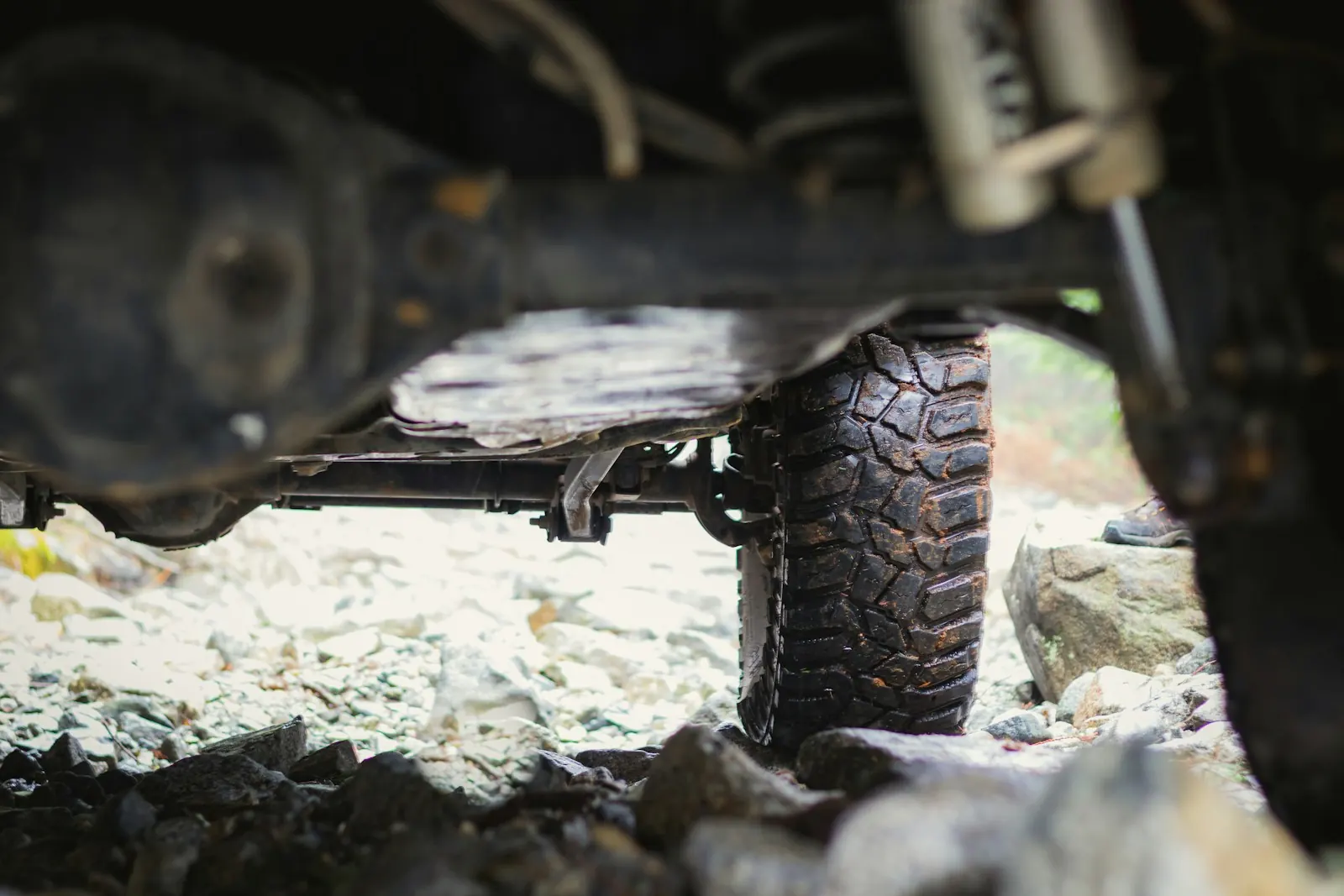
A Raptor owner expecting solid-axle simplicity is in for a surprise up front. The front end is independent suspension with constant-velocity (CV) half-shafts feeding each front wheel. That design is what lets the Raptor soak up high-speed desert whoops without the bump-steer of a solid axle — but it adds wear points a solid-axle truck doesn't have. The rear is conventional: a Ford 9.75 solid axle, the same family used across the F-150 line, sized up for the Raptor's loads.
Each front half-shaft has two CV joints packed with grease and sealed by a rubber boot. The boot is the weak link. When a boot tears, grease slings out and grit gets in. A dry, contaminated CV joint clicks under turning load, then fails. Catching a torn boot early — before the joint runs dry — is the difference between a $40 boot kit and a $450 half-shaft.
What to look for at every tire rotation:
- Grease flung in an arc on the inside of the wheel or on suspension components
- Cracked, split, or collapsed rubber boots at either end of the shaft
- A rhythmic clicking that rises with steering angle (a failing outer joint)
- A vibration or clunk on acceleration (a failing inner joint)
Long-travel suspension and big lifts increase the operating angle of the front CVs, which accelerates boot and joint wear. If you run a long-travel kit, treat CV inspection as a frequent, deliberate check rather than an occasional glance.
The rear axle is robust and rarely the problem on a stock-power Raptor. Its maintenance is gear oil and a clean breather. Ford specs synthetic 75W-140 for the Raptor's rear. The factory fill is good for a long interval on the highway, but hard desert running heats the diff, and water crossings can pull moisture past the breather into the gear oil.
Service guidance:
- Highway and mild trail: change rear gear oil at 60,000 miles
- Hard desert or regular trail use: 30,000 miles
- After any deep water crossing: check for milky, contaminated oil and change it if found
- If equipped with a Torsen or aftermarket limited-slip/locker, follow the unit maker's friction-modifier requirement
Front CV inspection needs nothing but a light and clean hands. A half-shaft replacement needs a 35mm axle nut socket, a breaker bar, a floor jack and stands, and basic metric sockets. Rear diff service needs a drain pan, a 3/8 socket for the cover bolts (or a fill/drain plug on later covers), RTV or a gasket, and the correct gear oil with the right friction modifier if you run a clutch-type limited slip.
The most common mistake is ignoring a torn CV boot because the joint still drives quietly. A quiet joint with a torn boot is on a countdown — grit is already grinding the bearings. The second mistake is overfilling or using the wrong gear oil in the rear; a clutch-type limited slip needs friction modifier or it will chatter in turns. The third is reusing the front axle nut — these stretch and are designed to be replaced.
A front CV boot kit runs $30–$50 per side; doing it yourself is an afternoon. A complete OEM front half-shaft is roughly $400–$500, with aftermarket units cheaper but variable in quality — for a truck that sees real desert speed, OEM or a known performance brand is the honest call. Rear gear oil service is $60–$90 in materials. A shop will charge $150–$350 labor for a half-shaft and $120–$200 for a rear diff service.
Steps
- Inspect front CV boots at every tire rotation — look for slung grease and cracked boots before you hear noise
- If a boot is torn but the joint is quiet, replace the boot and repack with CV grease promptly
- If the joint clicks under steering load, replace the half-shaft — a contaminated joint will not recover
- For half-shaft replacement: break the 35mm axle nut loose with the truck on the ground, then lift and support on stands
- Separate the lower control arm or tie rod as the service procedure requires, pull the shaft from the hub and the intermediate shaft/diff, and reverse to install
- Torque the axle nut to Ford spec and use a new nut — these are typically single-use crush or staked nuts
- For rear diff service: warm the oil with a short drive, drain, clean the cover mating surface, reseal, and refill with the correct 75W-140
- Run the diff breather hose check — a clogged or submerged breather is how water gets into the gear oil
Why it works
- Front CV inspection is free and catches the expensive failure early
- The rear 9.75 is durable and asks for little beyond clean gear oil
- DIY boot replacement saves the cost of a full half-shaft
Trade-offs
- IFS adds wear points a solid-axle truck doesn't have — more to inspect
- Long-travel and big lifts shorten CV joint life through steeper operating angles
- A neglected water crossing can quietly destroy a rear diff that looked fine
Tools required
- floor jack
- jack stands
- torque wrench
- axle nut socket (35mm)
- pry bar
- drain pan
- breaker bar
Parts
| Part | Vendor | Est. price |
|---|---|---|
| Front CV axle half-shaft (OEM Ford) | Ford | ~$450 |
| CV boot kit (per side) | Dorman / aftermarket | ~$40 |
| 75W-140 synthetic gear oil (rear, 9.75) | Motorcraft / Amsoil | ~$60 |
| Rear diff cover gasket / RTV | Ford / Permatex | ~$15 |
Sources
Related
- Raptor Front Differential and CAD: Fluid, Actuator, and Vacuum
- Raptor Driveshafts and U-Joints: Vibration Diagnosis and Service
- All Ford F-150 Raptor guides & tools
- Browse the full DIY database
Written and maintained by an AZ wheeler and driveway wrencher. How we source guides. Always cross-reference your factory service manual — modifications affect vehicle safety and warranty. Work at your own risk.