TJ Dana 44 Rear Axle — What the Rubicon Has and Why It Matters
Only the 2003 to 2006 TJ Rubicon left the factory with a Dana 44 in the rear (and a Dana 44 in the front), both with 4.10 gears and factory air-actuated lockers. Every other TJ has a Dana 35 rear, which is the weak point once you add 33-inch or larger tires, a locker, or hard trail use. If you want a Dana 44 behind a non-Rubicon TJ, the options are a used Rubicon axle, an aftermarket build, or strengthening the Dana 35.
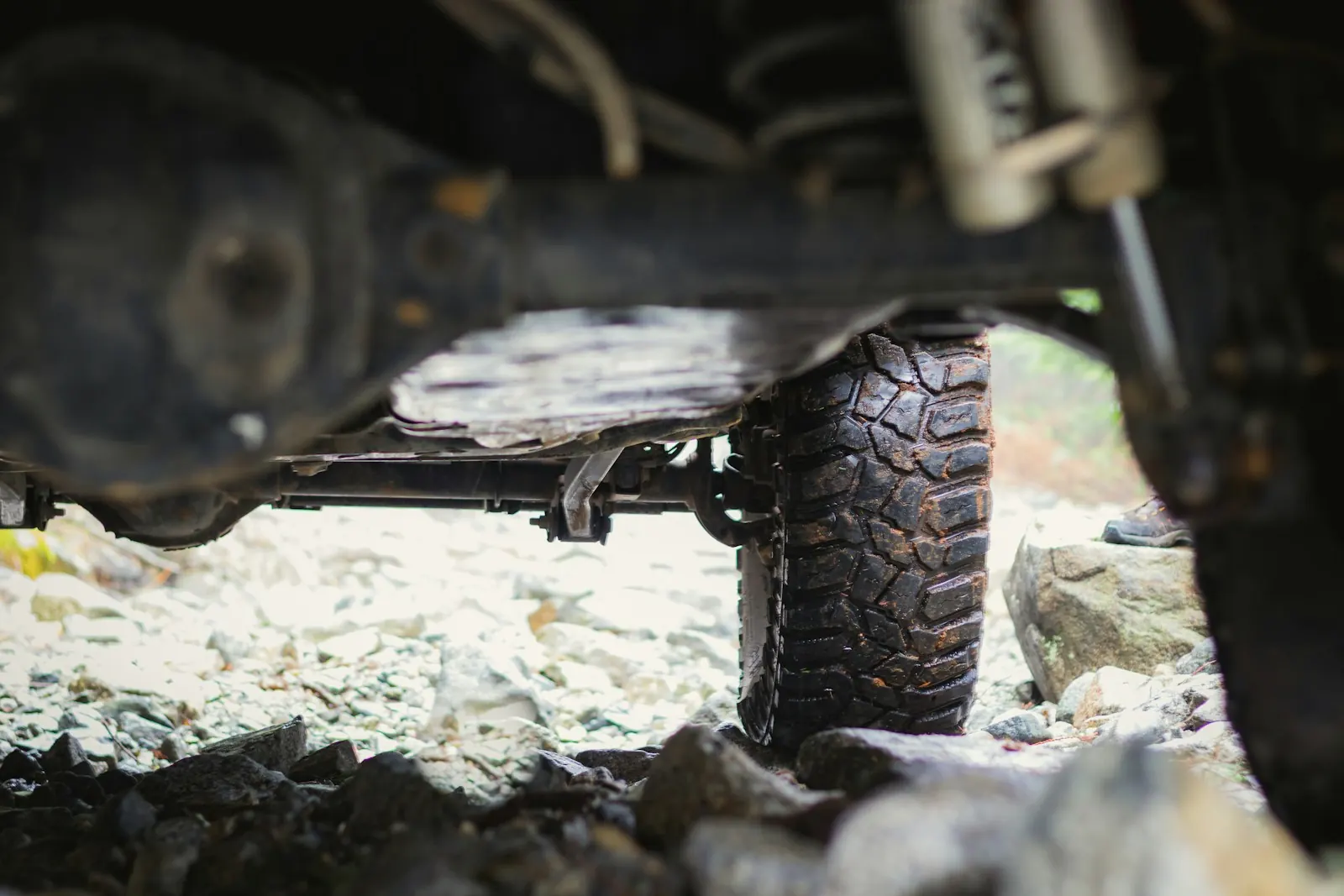
The Rubicon package was a 2003 to 2006 model-year option. It combined front and rear Dana 44 axles, 4.10 gears, front and rear Tru-Lok air-actuated lockers controlled by dash switches, and the Rock-Trac transfer case with a 4:1 low range. The Sport, Sahara, and X trims of the same years used a Dana 30 front and a Dana 35 rear. Most 1997 to 2002 TJs also used a Dana 35 rear. Verify by reading the axle tag or counting the differential cover bolts, because a swap or an owner-built axle is not unusual on a 20-year-old Jeep.
Dana 44 versus Dana 35 for a TJ, in plain numbers.
- Ring gear. The Dana 44 uses an 8.5-inch ring gear. The Dana 35 uses a smaller ring gear of about 7.5 inches. Larger gears tolerate more torque and abuse.
- Axle shafts. The Rubicon Dana 44 shafts are 30-spline. The Dana 35 shafts are 27-spline, and the Dana 35 is a C-clip design in which a broken shaft can slide out and take the wheel with it. Confirm your own axle design before relying on this, because earlier and later Dana 35 versions differ in details.
- Locker. The Rubicon axle's Tru-Lok is the strongest feature of the package, since you can switch from open to locked from the cab.
- Weight and cost. The Dana 44 is heavier and costs more to regear, but parts for it are plentiful.
Your realistic options when your TJ has a Dana 35:
- Keep the Dana 35 and be honest about its limit. On 31-inch tires, moderate trails, and a driver who avoids hard throttle on obstacles, it works. Add chromoly axle shafts if you are going bigger, and read TJ Dana 35 failures to know what breaks first.
- Swap in a Rubicon rear axle. A used Rubicon Dana 44 usually arrives with a factory locker, 4.10 gears, and sturdier shafts. Prices vary widely by region and condition: figure $800 to $2,000 and verify the price locally. Compatibility is not automatic. Check the spring perch spacing, the track bar bracket, shock mounts, brake line routing, parking brake cable length, and the ABS wiring against your Jeep. Measure the axle width and compare it to your existing axle. See TJ axle swap.
- Buy an aftermarket Dana 44. Builders sell complete rear axles with your choice of gears, locker, and full-floating or semi-floating configuration. Cost is typically $2,000 to $3,500 and up, and it makes sense for a dedicated crawler or a heavy build.
- Add a locker to the Dana 35. Many lockers are available for the Dana 35, but a locker adds load to a shaft that is already the weak link. Read TJ lockers and decide whether the money is better spent on a stronger axle.
- A confirmed axle identification (look at the axle tag and the cover)
- Floor jack and two axle-rated jack stands, plus a second set of stands to hold the axle
- Breaker bar, 1/2-inch drive socket set, and a torque wrench
- Dial indicator and a magnetic base if you set up gears yourself
- A bearing or seal driver set and a shop press (or a machine shop to do it)
- The correct gear oil, locker oil if needed, and a new cover gasket or RTV
- Service manual for torque specs and gear setup procedure
- Identify and verify the donor. Check for leaks at the pinion and axle seals, side-to-side play in the shafts, the condition of the wheel bearings, and whether the locker holds air if it has one. Ask for the 4.10 ratio confirmation on the tag.
- Park the Jeep on level ground, chock the front wheels, and lift the rear with a jack under the frame. Support the frame on jack stands and place the axle on a floor jack.
- Disconnect everything that is attached to the axle. Rear driveshaft, brake lines and hoses, parking brake cable, ABS sensor wiring if equipped, track bar, lower control arms, shocks, and sway bar links. Label what you remove.
- Lower the axle and roll it out. Keep the axle supported on the jack so the springs and shocks do not drop or bind.
- Install the new axle in reverse. Bring it up on the floor jack, attach the control arms and track bar loosely, then tighten them at ride height with the Jeep's weight on the suspension. This avoids binding bushings.
- Plumb the brakes and check. Reconnect the brake line, bleed the brakes, and test the pedal. This is a safety-critical system, so do not skip the bleeding step. Adjust the parking brake cable.
- Fill the axle and the locker system. Add the specified gear oil. If the locker is air-actuated, plumb the air line and the wiring harness for the switch; this is the most complex part of using a Rubicon rear axle in a non-Rubicon TJ.
- Check the speedometer. The Rubicon's 4.10 gearing differs from a typical Sport rear gear ratio. Mismatched front and rear ratios will bind the drivetrain in 4WD, so match both axles. If you change the ratio of one, change the other. See TJ regear.
- Road test carefully. Drive slowly, listen for whining or clunks, and recheck the gear oil level after the first few miles.
- Mixed ratios. Front and rear ratios must match. A 4.10 rear with a 3.73 front binds the drivetrain in four-wheel drive and loads the transfer case and axle parts.
- Bad used bearings. A whining axle can mean a worn pinion bearing, which is a $300 to $600 repair at a shop before you even install it.
- Locker wiring and air lines. The Rubicon lockers use an onboard air compressor and wiring to dash switches. If you are not carrying the Rubicon's compressor and harness over, the locker will not function.
- ABS and parking brake differences. Confirm sensor and cable compatibility before you commit.
- Torque specs. Bolt torque values vary by hardware and year. Use the service manual's numbers rather than a forum post.
- Over-torqued cover bolts. On a used axle, the cover bolts may be stuck or stripped. Use hand tools and care.
Costs and sources. Used Rubicon Dana 44 rear axle: $800 to $2,000 depending on region and condition. Aftermarket Dana 44 build: $2,000 to $3,500 and up. Chromoly shafts for a Dana 35: $350 to $600 per pair, depending on brand. Regear kit (ring and pinion, bearings, install kit): $450 to $700 in parts, with shop labor adding $400 to $800 per axle. Locker: $400 to $950 depending on type. Verify all prices with a quote from your local supplier before you commit.
Tools required
- floor jack
- jack stands
- axle stands
- breaker bar
- 1/2" impact
- bearing press or rental
- dial indicator for backlash setup
Parts
| Part | Vendor | Est. price |
|---|---|---|
| Alloy USA axle shaft kit — Dana 44 TJ rear | Alloy USA | ~$220 |
| Yukon Gear ring and pinion 4.10 — Dana 44 | Yukon Gear | ~$220 |
| ARB Air Locker — Dana 44 (35-spline) | ARB | ~$520 |
| Eaton Detroit Locker — Dana 44 | Eaton | ~$425 |
Sources
- TJ Rubicon Dana 44 Axle Specs — JeepForum
- Dana 44 vs Dana 35 — Trail Manual Database
- Yukon Gear Ring and Pinion Installation Guide
Related
- Dana 35 Rear: Known Failures and the Fix
- Chromoly Shafts and C-Clip Eliminators (TJ)
- Lockers for the TJ — Selectable, Automatic, and Budget Drop-In Options
- Re-Gearing the TJ — 4.56, 4.88, and 5.13 Ratios
- Axle Swap Paths for the TJ (D44, Ford 8.8, D60)
- All Jeep Wrangler TJ guides & tools
- Browse the full DIY database
Written and maintained by an AZ wheeler and driveway wrencher. How we source guides. Always cross-reference your factory service manual — modifications affect vehicle safety and warranty. Work at your own risk.