Axle Swap Paths for the TJ (D44, Ford 8.8, D60)
When you outgrow the Dana 30/35, there are three honest paths, and tire size picks the path — not budget. For 33s, reinforce what you have and stop reading. For 35s, a Ford 8.8 rear or a Dana 44 pair is the answer. For 37s and hard rock, one-ton Dana 60s are the end game. Buy for where the build is going, because doing perches, brackets, brakes, gears, and driveshafts twice costs more than buying the right axle once.
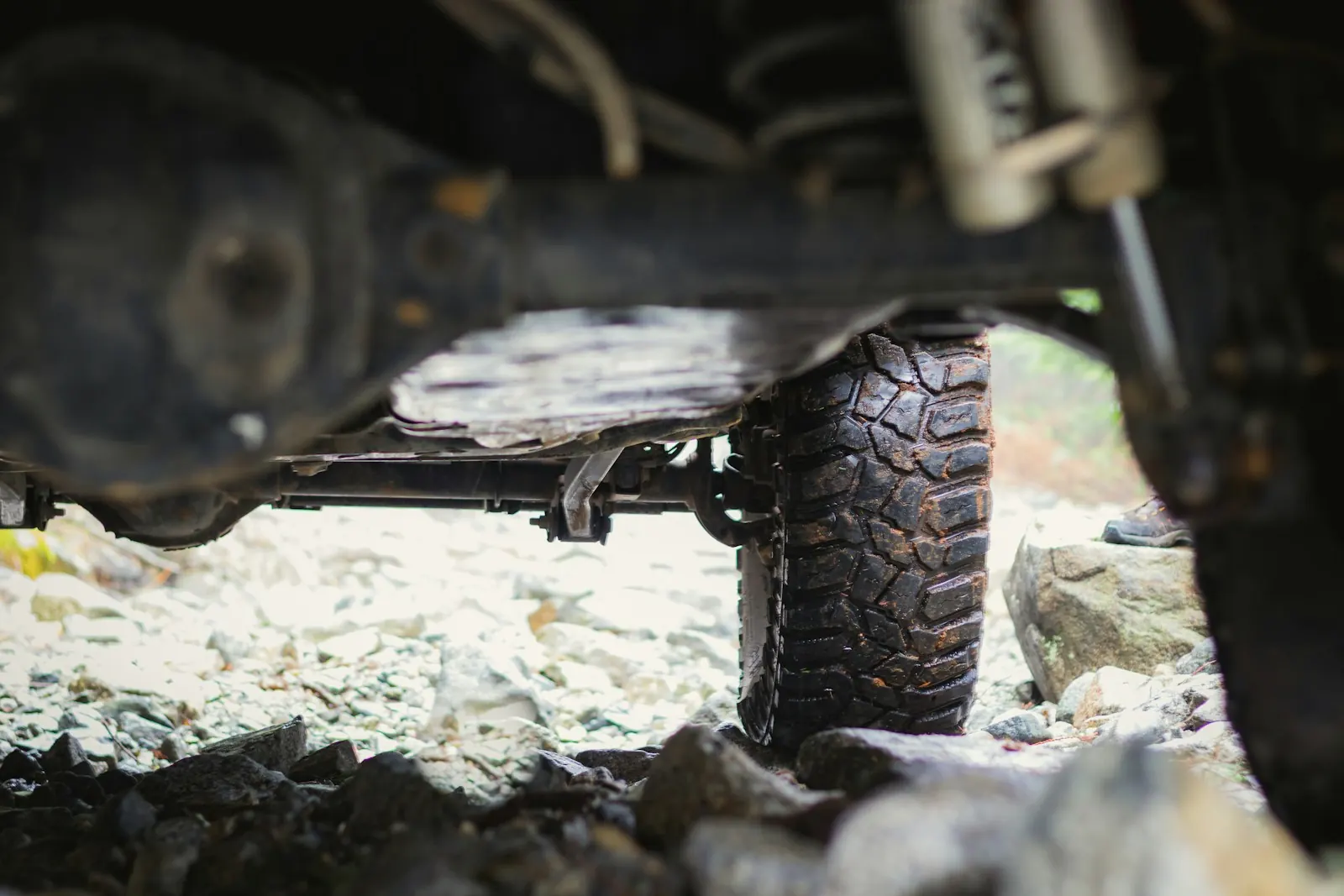
An axle swap is the most involved drivetrain work you can do to a TJ. Perches and control-arm brackets have to be cut off and re-welded at the correct pinion angle, brake and parking-brake lines have to be re-plumbed, the driveshaft length changes, and both ends need gears set up to the same ratio. None of that scales with the price of the axle — the labor is nearly identical whether you bolt in a $400 junkyard rear or a $6,000 built 60. That is the whole argument for matching the axle to your final tire goal on the first pass.
Before shopping, confirm the axles under the truck. A non-Rubicon TJ (1997–2006) runs a Dana 30 front — 7.125-inch ring gear, 27-spline shafts, unit-bearing hubs, 5-on-4.5 bolt pattern — and a Dana 35 rear with a 7.56-inch ring gear and 27-spline C-clip shafts. A 2003–2006 Rubicon runs Dana 44 front and rear with 30-spline shafts, 4.10 gears, and factory air lockers. Some non-Rubicon TJs left the factory with an optional Dana 44 rear; look for a 10-bolt oval cover and a stamped tag rather than trusting the seller.
Ratio matters as much as the housing. Factory ratios run 3.07, 3.55, 3.73, 4.10, and 4.56 on late SE autos. A 3.07-geared TJ is the trap — it feels fine stock and becomes undriveable on 33s, so check the door tag or count the ring-and-pinion teeth before you spend a dollar. The regear guide covers ratio selection; the Dana 35 failure modes guide covers whether yours is worth keeping at all.
A 1995–2001 Ford Explorer 8.8 is the cheapest large step up and the most common TJ rear swap for a reason. It brings an 8.8-inch ring gear, 31-spline non-C-clip shafts, and factory rear disc brakes, and its wheel-mounting-surface width lands within roughly an inch of the TJ Dana 35 — close enough that most owners run it with no spacer change. The bolt pattern is 5-on-4.5, the same as the Jeep.
The work is bracketry. Pull the Explorer perches and shock mounts, weld on a TJ coil-perch and lower-control-arm bracket kit (Ruffstuff, Artec, and Barnes 4WD all sell one for $120–250), set the pinion angle, and re-plumb the brake line and parking-brake cables to the Jeep's routing. Gears and a locker go in while the housing is out — an 8.8 takes an Eaton TrueTrac, an ARB, or a Yukon Grizzly, and aftermarket support is deep and cheap because of the Mustang crowd.
Honest limits: the 8.8 is a rear-only answer. Pair it with a reinforced Dana 30 for 33s or a Dana 44 front for 35s, and understand that a strong rear behind a stock front usually relocates the breakage rather than ending it.
A Dana 44 pair is the "do it right" route for a 35-inch build. Three sub-paths exist. Rubicon take-out 44s are the cleanest — correct width, correct brackets, factory lockers, and 4.10 gears already installed — and used sets run roughly $2,500–4,000 depending on condition and whether the lockers work. Aftermarket housings from Currie (RockJock 44), Dynatrac (ProRock 44), and TeraFlex (Tera44) start around $3,500 per axle bare and climb past $6,000 built, but come with thicker tubes, better shaft options, and a high-pinion front. The budget sub-path — a junkyard Dana 44 from a Wagoneer or a TJ 44 rear — is the cheapest 44 but drags width and bracket work with it.
The front 44 is the one that justifies the cost. A Dana 30 front with chromoly shafts survives 33s and most 35s if you are honest with the throttle, but a locked front on 35s in rock is where the 30's small ring gear and thin tubes give up. If the build includes a front locker, the 44 front stops being optional.
A front and rear Dana 60 set — usually a Ford Super Duty front and a Chevy or Ford rear, re-geared and re-bracketed — is the durable answer for 37s and up. The 9.75-inch ring gear and 35-spline shafts stop being the weak link in almost any TJ build.
What people underestimate is width and weight. A 60 set is roughly 69–70 inches wheel-mounting-surface to wheel-mounting-surface against the TJ's ~60 inches, so the track grows close to nine inches. That means highline or heavily flared fenders, new wheels with different backspacing, and a rig that no longer sits inside a standard trailer the way it did. The axles are also 8-lug unless you convert, and each end is 150–250 pounds heavier than what it replaces, which means re-valved shocks and heavier springs. This is a dedicated-trail-rig decision. Running 60s under a street-driven TJ on 35s is spending 1-ton money to carry 1-ton weight for no added capability.
Four items sink axle-swap budgets, and all four apply to every path above.
Brakes and the parking brake. Every swap changes caliper or drum plumbing, and Explorer and truck parking-brake cables do not match the Jeep's routing. Budget $150–350 for lines, a proportioning fix if you go rear disc from rear drum, and cable adapters.
Driveshafts. Any rear axle change alters pinion angle and shaft length. A TJ's rear shaft is short to begin with on a 93.4-inch wheelbase, so if the truck is lifted you are also into a slip-yoke eliminator and CV shaft at $600–900. Set the rear pinion 1–3 degrees below the driveshaft centerline with adjustable upper arms.
Gear setup. Both ends must run the same ratio, and a mismatched pair will destroy a transfer case. Unless you own a dial indicator, a bearing press, and a setup bearing kit, pay a shop $300–500 per axle. A howling diff is a full teardown redo.
Wheel fitment. Backspacing changes with every one of these axles, and the wrong offset puts the tire into the control arm at full lock or outside the fender. Sort wheels and tire fitment before the axle is under the truck, not after.
Ford 8.8 rear, DIY: $150–400 for the axle, $120–250 for brackets, $180–250 for gears, $80–150 for an install kit, $250–400 for a locker, $300–500 for setup labor, $150–300 for brake and cable work. All-in roughly $1,200–2,200 depending on how much welding you do yourself.
Rubicon Dana 44 pair, used take-outs: $2,500–4,000 for the axles, plus regear if the 4.10s do not match your tires ($700–1,100 for both ends with setup), plus brake and driveshaft work. All-in $3,500–6,000.
Aftermarket Dana 44 pair, new and built: $9,000–14,000 with gears, lockers, and shafts installed.
One-ton Dana 60 pair, used and re-worked: $3,000–5,000 for cores, $2,000–3,500 for gears, lockers, and setup on both ends, plus wheels, fenders, driveshafts, and steering. Realistically $8,000–12,000 before the first trail run.
On 33s, do not swap. Reinforce the Dana 30, add chromoly shafts if you are locked, and regear. On 35s, an 8.8 rear plus a reinforced or 44 front is the value answer and a Rubicon 44 pair is the clean one — see the Dana 44 rear guide for the rear-specific details. On 37s and up with a locked front and rock use, go to 60s and accept everything that comes with them. The wrong answer at every tire size is swapping one end, running it a season, and then swapping the other — that is two rounds of brackets, brakes, gears, and driveshafts to reach a place one decision could have taken you.
Tools required
- welder
- floor jack
- jack stands
- torque wrench
- grinder
Parts
| Part | Vendor | Est. price |
|---|---|---|
| TJ Rubicon Dana 44 (front and/or rear take-out) | various | ~$1800 |
| Ford 8.8 rear (junkyard + brackets) | various | ~$500 |
| Dana 60 set (1-ton, used) | various | ~$3000 |
Sources
Related
- Dana 35 Rear: Known Failures and the Fix
- TJ Dana 44 Rear Axle — What the Rubicon Has and Why It Matters
- Re-Gearing the TJ — 4.56, 4.88, and 5.13 Ratios
- All Jeep Wrangler TJ guides & tools
- Browse the full DIY database
Written and maintained by an AZ wheeler and driveway wrencher. How we source guides. Always cross-reference your factory service manual — modifications affect vehicle safety and warranty. Work at your own risk.