TJ Steel Front Bumper — Which Style to Buy and Why
Buy the bumper for the winch, not the look. A frame-mounted winch plate and real shackle tabs are the two things the stock TJ bumper can't give you; everything else (stubby vs. full-width, tube vs. plate, bash bar or not) is a tradeoff between tire clearance, protection, and weight. For most TJs a stubby or mid-width bumper with a winch plate in the $400–$500 range is the right buy — and if the budget is $100, a winch plate on the factory bumper is a legitimate first step, not a compromise.
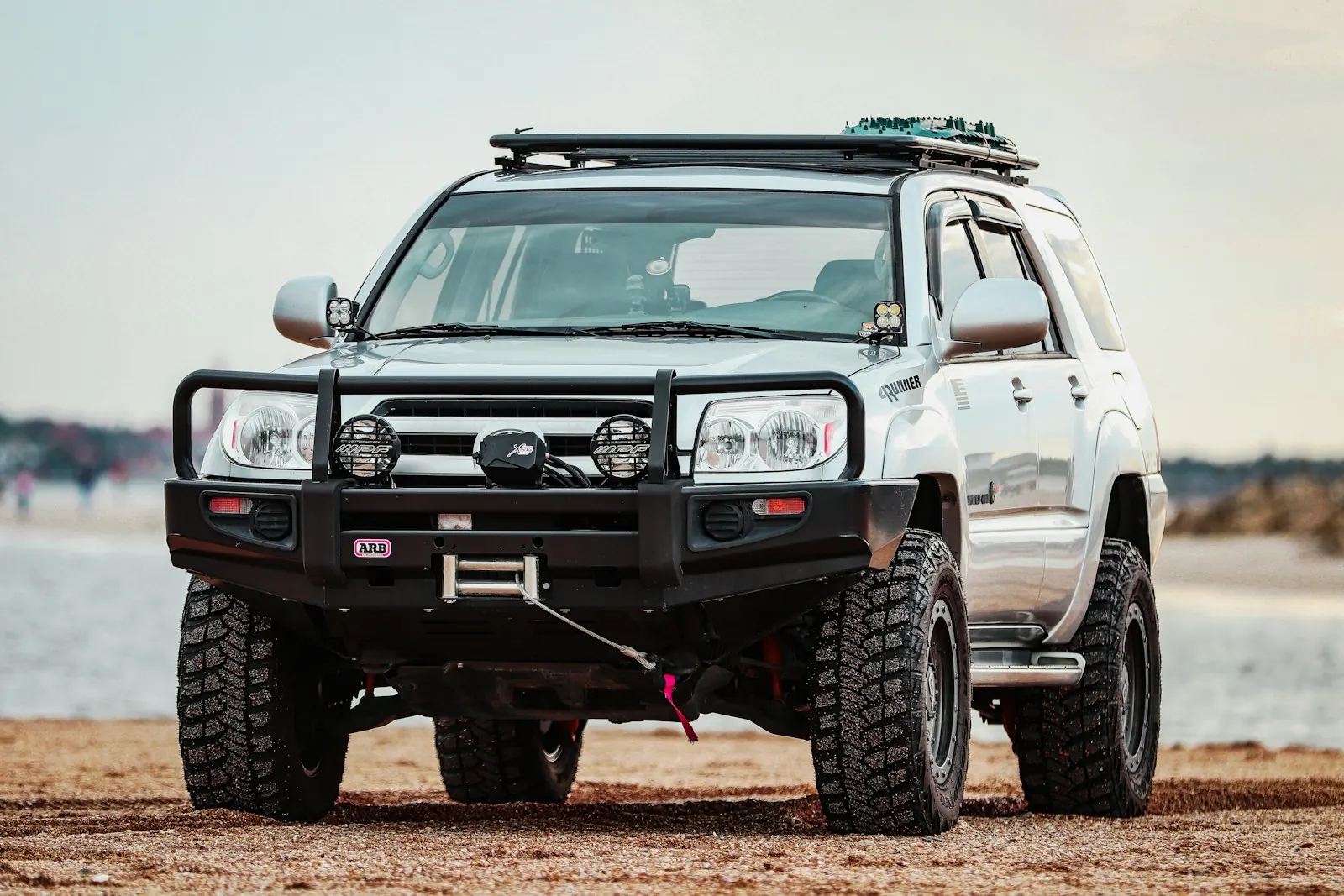
The 1997–2006 TJ shipped with a stamped-steel channel bumper (plastic end caps on Sahara, Rubicon, and some X models). It's stronger than the plastic JK bumper that came after it, and the factory tow hooks — where fitted — bolt through it into the frame horns, so a stock TJ is not helpless in a recovery. What the stock bumper can't do is carry a winch, and its end caps hang out past the frame where they catch rocks and scrub 33s at full lock. A steel replacement solves both, adds rated shackle tabs, and usually improves approach angle.
There are three decisions to make, in this order: where the winch mounts, how wide the bumper is, and how much steel you want to carry.
Every winch load — a self-recovery on a ledge, a 9,000 lb line pull on a stuck buddy — goes into the winch plate and then into whatever the plate bolts to. The plate must bolt to the frame horns, not to the bumper face. This is where cheap bumpers fail: a plate welded to a 3/16 in bumper face with no frame tie-in bends the face on the first hard pull. Look for a winch plate that either bolts through to the frame with its own hardware or sits on a bumper whose mounting brackets are welded directly under the plate.
The standard winch bolt pattern is 10 in × 4.5 in with four 3/8-16 bolts. Any 8,000–9,500 lb winch fits any bumper that lists that pattern; a 12,000 lb winch is longer (the drum is wider) and may not clear the bumper's side plates or fairlead opening. Buy the winch and the bumper as a pair, from the same spec sheet, and check that the fairlead mount is the standard 10 in spacing. Synthetic rope needs a hawse fairlead; steel cable needs a roller fairlead — some bumpers only fit one.
The $100 path: a winch mounting plate that sits on top of the factory bumper and bolts through it into the frame (Rough Country 1189, Warn, Smittybilt, Rugged Ridge all make one). The plate carries the winch; the factory bumper stays as trim. Owners run these for years. What you give up is shackle tabs (add bolt-on D-ring mounts to the frame horns, or use the factory tow hooks) and any protection or clearance improvement. If the winch is the only thing you need, this is the right buy and the money saved goes toward the winch itself.
Stubby (frame-width, roughly 30–34 in): best tire clearance at full lock, best approach angle, lightest. Nothing protects the fenders or grille corners. On a TJ running 33s or 35s with a 3–4 in lift, this is the layout that lets the front tires turn without hitting the bumper ends, which is why nearly every crawler runs one. Warn Rock Crawler, Smittybilt XRC (the TJ version is a stubby-leaning mid-width), JCR Crusader, and Poison Spyder Brawler Lite are all in this group.
Mid-width (roughly 40–48 in): covers the grille and headlight corners but stops short of the fender flares. The compromise most trail/daily rigs end up with. Poison Spyder Brawler Mid, Rock Hard 4x4 Patriot Mid.
Full-width (roughly 60 in, fender to fender): protects the flares and fender corners — the parts that get crushed sliding into a tree or dropping off a ledge sideways. Heaviest, and on a lifted TJ the outboard sections can interfere with 35s at full lock and full stuff. LOD Destroyer, Rock Hard Patriot full-width, GenRight's aluminum full-width. Best for overland rigs that carry a lot of front weight anyway and don't run extreme articulation.
Bash bars and grille hoops are a matter of use, not taste. A bar in front of the grille protects the radiator on a nose-first drop — genuinely useful for a rock rig. It also costs 3–5 degrees of approach angle on some designs, adds 10–15 lb, and blocks airflow slightly. Trail-and-daily rigs are better without one.
A stubby steel bumper runs 55–75 lb; a full-width plate bumper with a bash bar runs 90–130 lb. Add a winch (60–85 lb with rope and fairlead) and you've hung 120–200 lb off the nose. On worn 100,000-mile factory coils that's ½–1 in of sag, which also changes caster and can put the front driveshaft angle back into the range that whines. Plan for it: a ¾ in front coil spacer ($30–$50), or heavier-rate front springs when you do the lift (see TJ lift options and the front coil spring guide). Aluminum bumpers (GenRight and a few others) halve the weight for roughly double the price and no reduction in strength that matters for a bolt-on bumper.
- Disconnect the battery negative terminal if the rig has factory fog lights; you'll be cutting into their harness.
- Unbolt the factory tow hooks and bumper — two 18 mm bolts per side through the bumper into the frame horns. Rust-belt trucks: soak them the night before, and expect at least one to need a breaker bar. If a bolt snaps, the frame horn is open on the back so you can drill it out and run a bolt-and-nut.
- Pull the fog lights (Sahara/Rubicon/X) and unplug them at the harness connector. Most aftermarket bumpers accept 3–4 in round pod lights; the factory lamps only refit on bumpers that specifically list them.
- Inspect the frame horns. Look for rust-through, cracks at the tow-hook bolt holes, and the frame-to-crossmember welds. A winch pull loads all of this. Any rot here gets fixed before a winch goes on — this is the same inspection covered in the recovery points guide.
- Bolt the winch to the winch plate on the bench if the design allows it — far easier than working the four 3/8 in bolts blind. Mount the fairlead. Route the winch power leads now, before the bumper goes on.
- Set the bumper on a floor jack, raise it into position, and start every mounting bolt by hand before torquing any. Center it: measure from each frame rail to the bumper end and match the two sides.
- Torque the frame bolts to the kit spec — typically 60–75 ft-lb for the grade-8 ½ in or M12 hardware most kits supply. Use the supplied bolts, not the factory ones, unless the instructions say otherwise.
- Wire the lights and winch. Winch positive goes to the battery through a disconnect or breaker if the kit supplies one; the negative to the battery, not the frame. Fog/pod lights get their own fused, relayed circuit off the battery — do not tap the factory fog light circuit for anything bigger than the OE lamps.
- Check clearances with the front axle at full droop and again at full compression (jack under the axle until the bump stops touch): bumper-to-grille, bumper-to-tire at full lock, fairlead-to-anything the rope could saw through.
- Shackle tabs. Confirm the bumper has welded D-ring/shackle tabs with a ¾ in pin hole and a rated backing. Budget bumpers sometimes have decorative tabs welded to the face plate only — same failure mode as a face-mounted winch plate. Bolt-on frame-horn D-ring mounts are the fallback.
- Rubicon and 03–06 fog light wiring is behind the bumper on a short pigtail. Extension harnesses ($20) save you from splicing.
- Powder coat vs. paint. Powder coat chips and then rusts under the coating where you can't see it; touch every chip with cold galvanizing spray as it happens. A painted bumper is easier to keep on top of.
- Tire rub at full lock on full-width bumpers with 35s — check with the steering at each lock and the axle stuffed before you finish torquing.
- Sway bar disconnects on some aftermarket bumpers with low bash bars: the disconnect link swings forward at full droop and can hit the bar. Cycle it.
| Path | Cost | What you get |
|---|---|---|
| Winch plate on factory bumper | $90–$200 | A winch. No shackle tabs, no clearance gain. |
| Stubby with winch plate (Smittybilt XRC 76800, Rugged Ridge XHD, Warn Rock Crawler) | $400–$550 | Winch, shackle tabs, best tire clearance and approach |
| Mid-width plate (Poison Spyder Brawler Mid, Rock Hard Patriot) | $600–$800 | Grille corner protection, optional bash bar |
| Full-width plate (LOD Destroyer, Rock Hard full-width, GenRight aluminum) | $700–$1,100 | Fender protection, most weight (or aluminum at ~$1,300+) |
Install is 1–3 hours bolt-on for any of them; add an hour for fog light relocation and another for winch wiring. The $450 tier is not a stepping stone — the XRC and XHD are competent bumpers that most TJs never outgrow. The money above that buys thicker plate, cleaner welds, a better finish, and a bash bar, not a different capability. Spend the difference on the winch or the rear bumper instead.
Tools required
- socket set (18mm for the factory bumper bolts)
- torque wrench
- floor jack (to hold the new bumper at height)
- wire strippers and heat-shrink connectors (if relocating fog lights)
- tape measure
Parts
| Part | Vendor | Est. price |
|---|---|---|
| Rough Country winch mounting plate for the factory TJ bumper | Rough Country | ~$100 |
| Smittybilt XRC front bumper with winch plate — 97-06 TJ/LJ | Smittybilt | ~$450 |
| Rugged Ridge XHD modular front bumper (base + winch plate) | Rugged Ridge | ~$420 |
| Warn Rock Crawler stubby front bumper — TJ | Warn | ~$500 |
| Rock Hard 4x4 Patriot Series full-width front bumper — TJ | Rock Hard 4x4 | ~$650 |
| Poison Spyder Brawler Lite / Brawler Mid front bumper — TJ | Poison Spyder | ~$700 |
| LOD Destroyer Series full-width front bumper — TJ | LOD Offroad | ~$895 |
Sources
- Smittybilt XRC Front Bumper, 97-06 TJ/LJ (76800)
- Rough Country Winch Mounting Plate, 97-06 TJ / 04-06 LJ
- Quadratec — 1997-2006 Wrangler TJ winch mounting options
- Winch on a stock TJ bumper — owner install thread (WranglerTJForum)
Related
- TJ Steel Rear Bumper — Tire Carrier, Recovery Points, and Hitch
- TJ Skid Plates — What the Factory Already Covers, What It Doesn't, and the Tummy Tuck
- Winch Selection for the TJ Wrangler
- TJ Recovery Points — Rated Anchors for Self-Recovery and Being Pulled
- All Jeep Wrangler TJ guides & tools
- Browse the full DIY database
Written and maintained by an AZ wheeler and driveway wrencher. How we source guides. Always cross-reference your factory service manual — modifications affect vehicle safety and warranty. Work at your own risk.