Spring-Over and Coil Conversions for Big TJ Lift
The TJ is coil-sprung, so a true leaf "spring-over" does not apply the way it does to a YJ — the big-lift path here is a long-arm or coilover conversion, not flipping springs. If you are chasing 6 inches and 37s, that is a fabrication build with steering, driveline, and brake work, not a bolt-on. For most TJs, stop at a 4-inch short-arm and 33s; the guide below is for the owner who has decided not to.
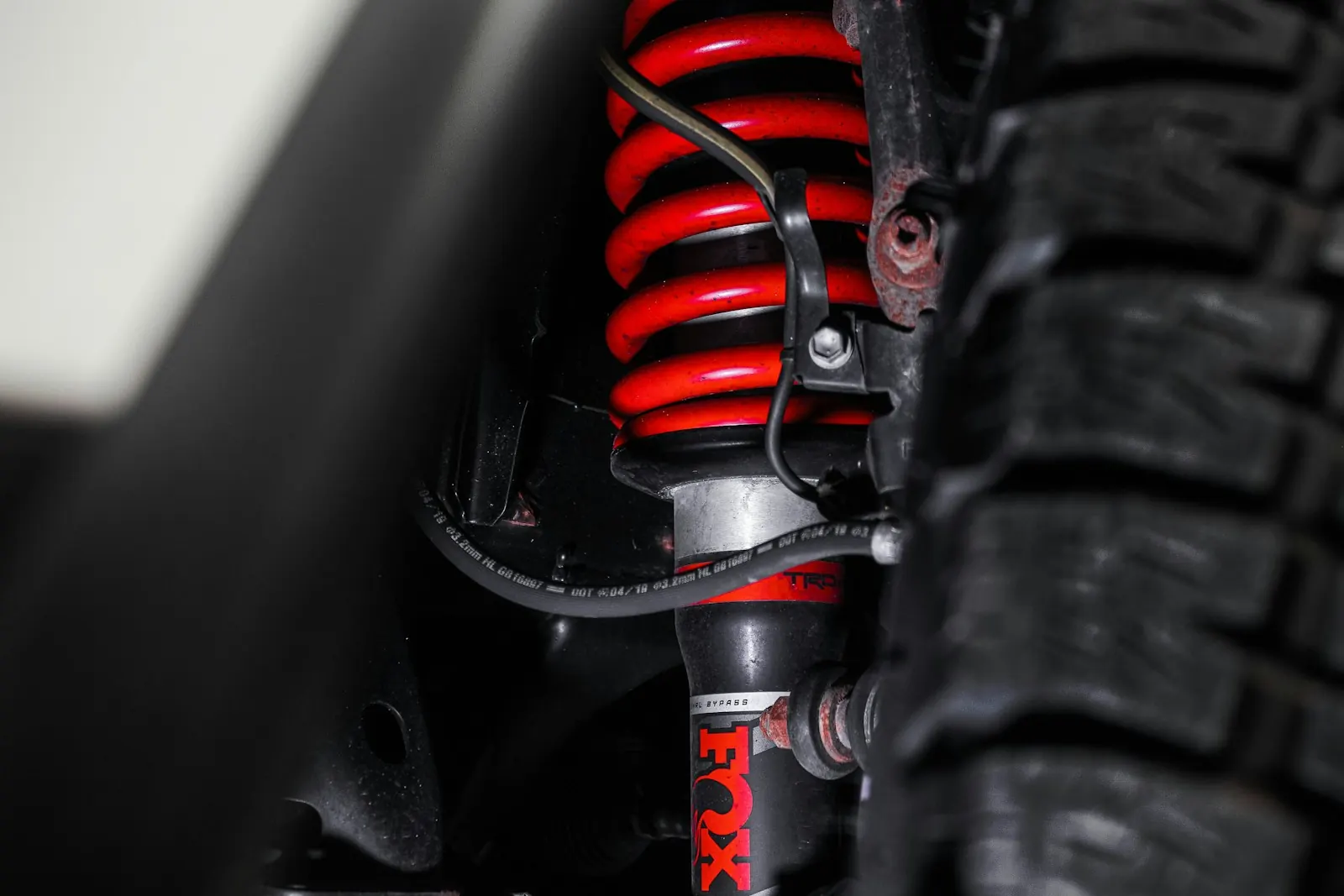
Because the TJ uses coils and control arms front and rear, gaining serious height means re-engineering the geometry, not relocating a leaf pack. The two real paths past ~4 inches are a long-arm kit (relocated mounts, longer arms) or a coilover conversion (the dedicated crawler route). Both are welding-and-fabrication jobs, and both drag the steering, driveline, and brakes along with them. If you searched "spring over" because a YJ friend told you about it, read the short-arm vs long-arm breakdown first — the TJ equivalent of the YJ's big cheap lift does not exist.
A YJ spring-over moves the leaf pack from under the axle to on top of it and nets 4–6 inches for the price of new perches and a weekend. It works because a leaf spring is both the spring and the locating link. The TJ separates those jobs: coils carry the weight, four control arms per axle locate it, and a track bar keeps it centered side to side. There is nothing to flip. Height on a TJ comes from taller coils, and every inch of taller coil steepens the control arms, pulls the axle rearward on compression, and tilts the pinion. Past ~4 inches the stock-length arms (roughly 15–16 inches) are steep enough that the ride turns harsh, the wheelbase shrinks noticeably under load, and the front axle's caster and pinion angle can no longer both be set right. That is the wall a long-arm or coilover kit is built to get past.
A long-arm kit replaces the frame-side lower mounts with a new crossmember or bracket set further back, and runs arms roughly twice the factory length. The flatter arc restores ride quality and flex at 5–6 inches and keeps the axle from walking rearward on compression. Name-brand kits for the TJ run about $2,500–4,000 depending on shock and bushing choices: Rubicon Express's 4.5-inch long-arm system, Clayton's 4–6 inch long-arm kits, Rock Krawler's X-Factor long-arm, and Metalcloak's long-arm Game-Changer are the usual picks, and the Currie/Savvy "mid-arm" using a belly-up skid is the middle route that gains arm length without a hanging crossmember. Plan a full weekend with a welder and grinder even for kits marketed as bolt-in — the crossmember goes in with bolts, but every one of these ships with brackets that want tacking, and the old lower mounts have to come off. Read the long-arm lift guide for the install itself; this guide is about what surrounds it.
A coilover conversion throws out the coil-and-shock pairing for 2.0- or 2.5-inch remote-reservoir coilovers on fabricated hoops, usually front only, with the rear either on a matching coilover setup or a long-travel coil-and-shock package. Rock Krawler, GenRight, and EVO sell TJ-specific front coilover kits in the $3,000–5,000 range before the rear, and a finished front-and-rear system with tuned springs and a quality long-arm underneath lands at $6,000–9,000 in parts. What you buy is adjustability — ride height, spring rate, and damping are all tunable — and wheel travel that a coil-and-shock setup cannot match. What you pay is fabrication: the hoops are welded to the frame, the fenders come off or get replaced with highline flares, and the whole front end gets cycled with the springs out to find every contact point before it is final. This is not a driveway job unless the driveway has a welder and a lift.
Three systems must be addressed together or the truck becomes unsafe, and each has a real cost.
Steering. At 5–6 inches the drag link and track bar are no longer parallel, which is the geometry that produces bump-steer and feeds death wobble. The cheap fix is a drop pitman arm and a track-bar relocation bracket ($150–250 combined); the correct fix at this height is high-steer — flipping the drag link to the top of the knuckle with a Currie or Reid high-steer knuckle and a new tie-rod/drag-link set, $700–1,200. Pair it with an adjustable track bar mounted on a raised axle-side bracket so both bars sit at the same angle. Hydro-assist is a separate conversation; big lift does not require it, 37s and a locked front do.
Driveline. The TJ's rear driveshaft is short — around 16–18 inches on a 93.4-inch wheelbase — so even a 2-inch lift changes its operating angle noticeably, and at 5–6 inches the factory slip-yoke shaft will vibrate and eat u-joints. A slip-yoke eliminator on the NP231 plus a double-cardan CV driveshaft is mandatory ($600–900 installed with a Tom Woods or JE Reel shaft); see the SYE guide. 2003–2006 Rubicons already have the NV241OR's fixed yoke and skip the SYE but still need the CV shaft. Set the rear pinion 1–3 degrees below the driveshaft angle with the adjustable upper arms. The front driveshaft also gets long enough at 6 inches that some kits ship a new one; check yours at full droop for slip-yoke pull-out.
Brake lines and bump stops. Factory rubber brake lines will pull taut and can tear at full droop on a 5-inch-plus setup — extended stainless lines run $80–130 for a set. Bump stops must be extended by roughly the lift height so the tire does not meet the fender or the coil does not unseat under compression, and the coil retainers should be upgraded so a fully-drooped spring stays put. Longer sway-bar links or disconnects come with any kit; at this height most owners run quick-disconnects and leave the bar off on the trail.
A 6-inch TJ on 37s is roughly 4 inches taller at the roofline and has moved its center of gravity up while the track width stayed at the factory 58.5 inches. That is a tippy combination on off-camber trail, which is why coilover builds almost always add width — 1.25–1.5-inch wheel spacers or wheels with 3.5–3.75-inch backspacing — and why serious crawlers eventually swap in wider axles. The 35-inch tire fitment guide covers the trimming, and 37s need highline flares or a hard cut of the front fenders on any lift under 6 inches. Regearing is not optional at this tire size: 4.88s for 35s, 5.13s for 37s on a 4.0L, and the Dana 35 rear has to be replaced before any of it — see the Dana 35 guide.
A 6-inch, 37-inch TJ is a trailer-or-dedicated-crawler build. It will not drive like a stocker, and the higher center of gravity needs the wider track and careful tuning that come with a real coilover kit. If you mostly daily-drive and hit trails on weekends, the payoff is not there — a 4-inch short-arm on 33s with a locker will out-wheel a badly sorted 6-inch build every time, and it will still make the freeway drive home.
A realistic all-in budget for the long-arm path at 5–6 inches: long-arm kit $2,500–4,000, SYE and CV driveshaft $600–900, high-steer or drop-pitman steering $250–1,200, adjustable track bar and bracket $200–300, extended brake lines and bump stops $150–250, regear front and rear $1,200–1,800 at a shop, and the axle swap the Dana 35 forces at 35s-plus, $1,500–3,000. That is $6,500–11,000 before tires and wheels. The coilover path adds roughly $3,000–5,000 on top for the coilovers, hoops, and fabrication. Parts sources are the kit makers directly (Rubicon Express, Clayton, Rock Krawler, Metalcloak, GenRight, Currie/Savvy), Tom Woods or JE Reel for driveshafts, and a local shop with a proper gear-setup bench for the regear. Budget the fabrication labor honestly — a shop will bill 20–40 hours for a coilover front end that is cycled and tuned properly.
Run a 4-inch short-arm on 33s and you have a TJ that crawls hard and still drives home comfortably. Reach for the long-arm or coilover conversion only when the trail genuinely demands 35s-plus and you are ready for the fabrication, the steering work, and the driveline cost that come with it — and do the steering, SYE, and brake lines in the same weekend as the lift, never "later."
Tools required
- welder
- grinder
- floor jack
- jack stands
- torque wrench
Parts
| Part | Vendor | Est. price |
|---|---|---|
| Long-arm or coilover conversion kit | Clayton/Rock Krawler/EVO | ~$2800 |
| SYE + CV driveshaft | JB Conversions/Tom Woods | ~$700 |
| High-steer / drop-pitman steering kit | various | ~$400 |
Sources
Related
- Short-Arm vs Long-Arm: Which TJ Lift You Actually Need
- Long-Arm Lift System — 4.5"+ for Rock Crawling ($2,000+)
- SYE Kit for the NP231 Transfer Case — Eliminating Driveshaft Vibration
- All Jeep Wrangler TJ guides & tools
- Browse the full DIY database
Written and maintained by an AZ wheeler and driveway wrencher. How we source guides. Always cross-reference your factory service manual — modifications affect vehicle safety and warranty. Work at your own risk.