Winch Selection for the TJ Wrangler
An 8,000–9,500 lb winch is the right size for a TJ — the rig's GVWR sits between 3,500 and 4,000 lbs, and the 2x rule for winch capacity puts you squarely in this range.
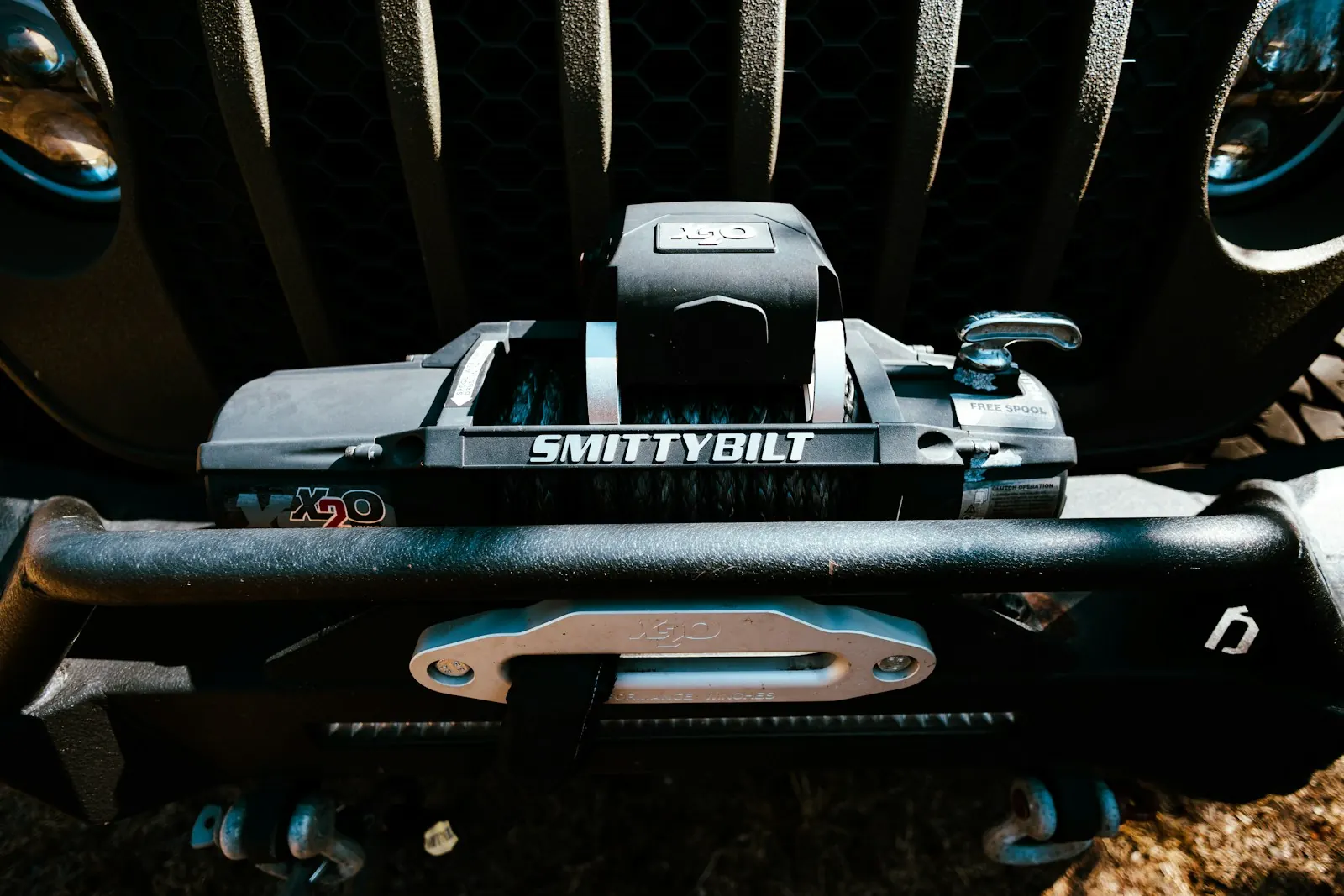
The TJ's curb weight is approximately 3,200–3,500 lbs depending on spec, and GVWR tops out around 4,000 lbs with a loaded rig. The standard recovery calculation is twice the vehicle weight for winch capacity, which means 7,000–8,000 lbs is the floor and 9,500 is a sensible ceiling. A 12,000 lb winch will technically work on a TJ, but it adds weight and wiring requirements without providing any practical benefit — the pull capacity you'd use in a real recovery scenario tops out well below what an 8,000 lb unit handles.
Warn remains the benchmark for built-in-the-USA winch quality. The M8000 ($499) has been a trail standard for over a decade — known for consistent performance, a robust motor, and Warn's parts/warranty support. The VR EVO 8 ($399) is the current-generation value tier from Warn: it gives you Warn reliability and a 3-stage planetary gear system at a lower price point by using a different motor spec and a more straightforward remote. For most TJ owners, the VR EVO 8 is the right choice.
Smittybilt's X20 Gen2 ($329) comes with a synthetic rope from the factory, which is a meaningful safety advantage over steel cable. Synthetic rope doesn't store kinetic energy the way steel cable does — when steel cable snaps under load, it recoils with force proportional to the stored tension. A synthetic rope failure is dramatic but far less dangerous. If the budget dictates a Smittybilt over a Warn, the X20 Gen2 is the pick. Expect the motor and solenoid to work harder than a Warn under heavy repeated use — it's a trail winch, not an arborist winch.
A winch is useless without a winch-capable bumper. Verify your front bumper has a proper winch mount plate tied into the frame rails before purchasing. A fairlead (hawse for synthetic rope, roller fairlead for steel cable) is required and typically not included with the winch.
Steps
- Verify front bumper has a winch-compatible mounting plate with frame tie-in.
- Slide winch into bumper mounting channel; start all four mounting bolts hand-tight.
- Torque winch mounting bolts to 55–65 ft-lbs.
- Route power cables to the battery: positive to battery positive terminal, negative to battery negative or chassis ground. Route cables away from heat sources and sharp edges; use loom or split conduit.
- Install solenoid box per manufacturer instructions (typically mounts to the winch or bumper with included hardware).
- Verify power connections are tight and sealed with dielectric grease.
- Install hawse fairlead (for synthetic rope) or roller fairlead (for steel cable) to bumper fairlead opening. Torque to 15–20 ft-lbs.
- Spool the winch line through the fairlead and confirm correct drum direction — winch should pull from the bottom of the drum.
- Test-fire the winch under no load in both directions with the remote. Verify solenoid actuation.
- Apply winch line to a stationary point and test under light load before trail use.
Why it works
- 8,000–9,500 lb capacity is correctly sized for the TJ's weight — neither under- nor over-spec
- Warn VR EVO 8 delivers brand-name reliability at a meaningful discount vs. the M8000
- Synthetic rope (Smittybilt X20) is safer than steel cable in a snap scenario
- Self-recovery capability removes dependence on trail partners for getting unstuck
- Doubles as an anchor for vehicle-assisted tree pulls and recovery assistance for others
Trade-offs
- Requires a winch-compatible steel front bumper — adds to total cost if not already installed
- Wiring installation must be done correctly or the winch will underperform or damage the electrical system
- Winch adds 60–85 lbs to the front axle weight — affects handling and front suspension loading
- Steel cable kinetic snap hazard — if using a steel-line winch, always drape a recovery blanket over the line during a pull
- Winches are not waterproof — avoid submerging past the motor housing without a waterproofing kit
Tools required
- socket set
- torque wrench
- wire strippers
- crimping tool
- heat gun (for heat-shrink connectors)
Parts
| Part | Vendor | Est. price |
|---|---|---|
| Warn M8000 Electric Winch (8,000 lb capacity, steel cable) | Warn Industries | ~$499 |
| Warn VR EVO 8 Electric Winch (8,000 lb capacity, steel cable) | Warn Industries | ~$399 |
| Smittybilt X20 Gen2 9,500 lb Winch with Synthetic Rope 98495 | Smittybilt | ~$329 |
| Mile Marker 8000 Electric Winch (8,000 lb capacity) | Mile Marker Industries | ~$299 |
Sources
- JeepForum — TJ Winch Selection and Install Guide
- Warn VR EVO 8 Product Page and Specs
- Overland Journal — Synthetic vs. Steel Winch Line Comparison
Related
Written and maintained by an AZ wheeler and driveway wrencher. How we source guides. Always cross-reference your factory service manual — modifications affect vehicle safety and warranty. Work at your own risk.