Shock Absorber Upgrade — OME, Bilstein, and Fox Options
Shock quality is where budget lift kits lose ground the fastest — replacing the included shocks with a set of OME, Bilstein, or Fox units is one of the highest-return investments you can make on a TJ.
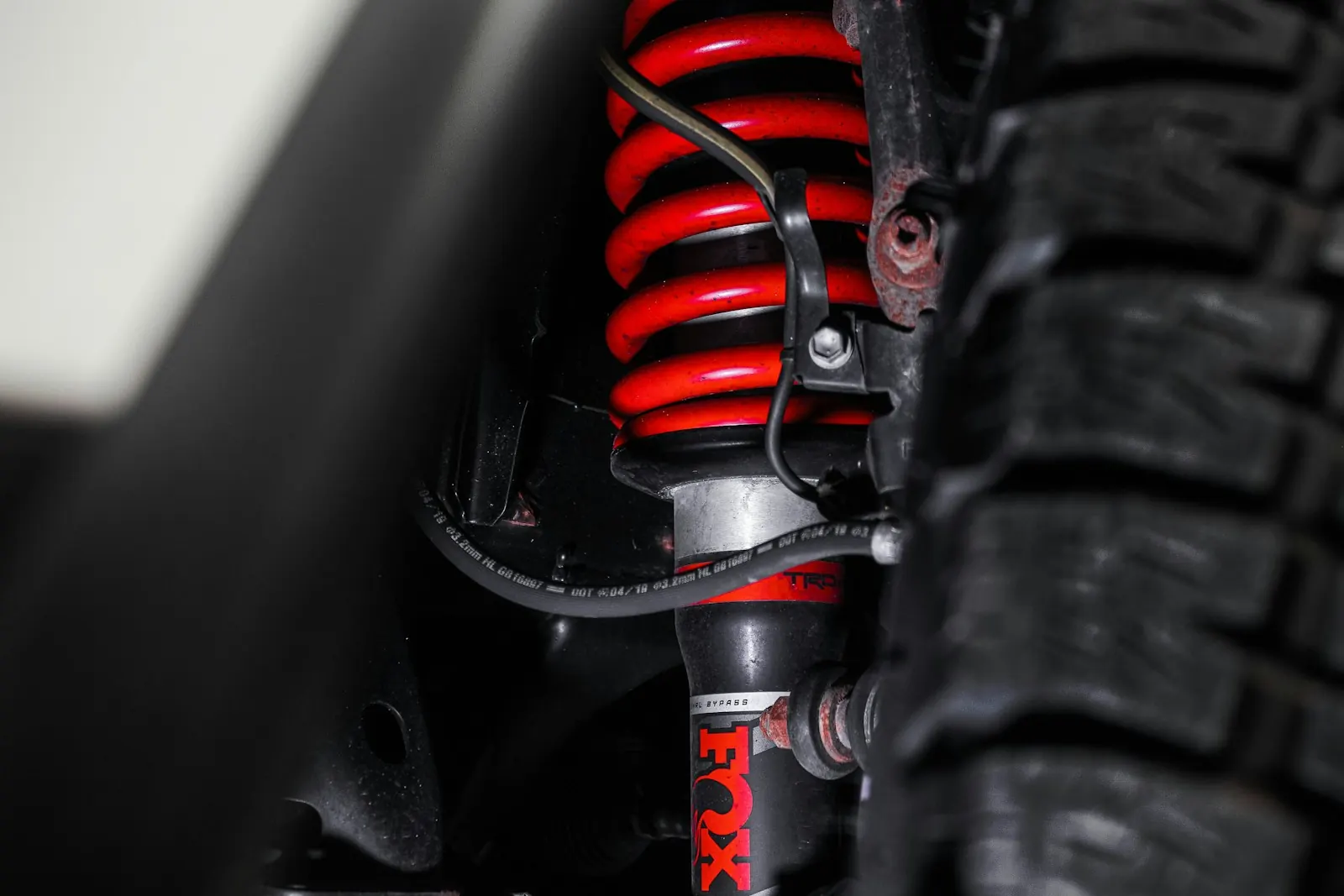
Shock absorbers are the component most budget lift kits shortchange. A spring moves the vehicle; a shock controls how fast it moves and damps the oscillation. An undersized or overvalved shock on a TJ produces a ride that either bobs continuously on pavement or bottoms out hard on trail impacts. The TJ's coil-spring suspension responds extremely well to quality shocks because the coil springs themselves have relatively linear rates; the damper is doing the majority of the ride-quality work.
OME's Nitrocharger Sport remains the value standard for TJ overland builds. The low-pressure gas-charged twin-tube design resists fade better than a plain oil-filled shock and is tuned conservatively for ride comfort, and OME calibrates their valving specifically for loaded TJs — they account for the extra weight of armor, tools, and camping gear that's typically on an overland rig. The OME set at $380–$450 is the pick if you want the best ride quality on pavement with competent trail performance. OME shocks are sized for their own spring kits, so verify fitment against your lift height before purchasing.
Bilstein's 5100 series is a serious performance upgrade with a monotube design and zinc-plated body. Bilstein valves their shocks for consistent performance across the range from full bump to full droop — they feel firmer than OME on pavement but provide notably better control on rough trail surfaces where damper velocity is high. The 5100 is the choice for a TJ that's on technical trails regularly and needs a shock that can keep up with repeated high-frequency inputs.
Fox 2.0 Performance shocks are the upper tier in this category: larger 2.0" diameter body, better heat dissipation on extended trail use, and adjustable rebound damping on some configurations. For builds at 3"–4" of lift with 35" tires that see serious trail use, the Fox 2.0 is worth the premium. For anything milder, OME or Bilstein is the right answer.
Shock length is the most common reason a TJ shock swap goes wrong. A shock must be longer than the axle's total travel at full droop and shorter than the collapsed distance at full bump, or it will either limit droop (hanging the tire or topping out the shock) or bottom out (damaging the shock and the mount).
- With the Jeep on level ground at ride height, measure eye-to-eye (mount center to mount center) on each corner.
- Jack the frame up until the tire barely leaves the ground to measure full droop, and lower the axle until the bump stop contacts to measure full bump. The shock's extended length should be a little more than the droop figure and the collapsed length a little less than the bump figure.
- Check that the factory-style limiting straps or the lift kit's droop limiter do not stop the axle sooner than the shock allows.
Compare those numbers with the extended and collapsed lengths published by the manufacturer for the lift height you run. A TJ lifted 3 inches uses a different shock than a stock-height TJ; the shock listed for 0-2.5 inches will not fit the same way at 4 inches without limit straps.
Worn shocks announce themselves. The signs are oil film on the shock body, a bounce that continues after you push down hard on a fender and release it, nose dive under braking, a floating feel on the highway and a clunk from a worn eyelet bushing. Shocks wear gradually, so a 60,000-mile TJ often feels fine until you drive a fresh set. Replace the shocks as a set of four, and replace the bushings and mounting hardware at the same time; a new shock on a worn bushing clunks within weeks.
- Budget (about $200-$300 for a set): a Rancho RS5000X-class twin-tube gas shock is a competent step up from the lift-kit shocks in a bargain kit, and good enough for a daily driver on 31-33 inch tires that sees mild trails.
- Mid ($380-$520): OME or Bilstein 5100 for a loaded overland TJ or an occasional rock rig.
- Premium ($700+): Fox 2.0 or a reservoir shock when the Jeep sees repeated high-speed washboard, long descents or desert use. Reservoir shocks buy heat capacity; they do not add travel.
A shock does not change the ride height; the springs do. If the Jeep sits lower on one side or the front is nose-down after a shock swap, the problem is the springs or the bump stops, not the shocks. Read the budget lift and mid lift guides to size the springs first, then choose the shocks to match, and check the steering stabilizer guide if you are chasing a front-end shimmy that the new shocks did not cure.
Steps
- Raise the vehicle at the frame rails and support on jack stands. Keep the axle supported on a separate floor jack to allow adjustment of suspension height.
- Spray all shock hardware with penetrating oil and allow 10–15 minutes to soak on any vehicle over five years old.
- Remove the top shock mount nut while holding the shock shaft with a second wrench to prevent spinning.
- Remove the lower shock mount bolt.
- Slide out the old shock; slide in the new shock. Orient the shock so the reservoir (if present) is positioned per manufacturer instructions.
- Install lower mount bolt hand-tight. Install top mount nut hand-tight.
- Load the suspension to ride height (lower the axle jack until the vehicle rests normally) before torquing fasteners.
- Torque the upper and lower shock fasteners to the values printed on the manufacturer's instruction sheet for your shock (they differ by brand and bushing type). Do not guess from memory or forum posts.
- Repeat for all four corners.
- Drive 50 miles and check all fasteners.
Why it works
- OME Nitrocharger Sport provides the best on-pavement ride quality in the under-$500 price range for TJ applications
- Bilstein 5100 provides consistent trail performance across a wide range of input speeds
- Fox 2.0 Performance handles heat and repeated high-velocity inputs better than twin-tube designs at this lift height
- All three brands are TJ-specific fitments — correct lengths and mounting geometry are well-documented
- Shock upgrade is independent of spring changes — can be done as a standalone upgrade on any existing lift kit
Trade-offs
- Shock length must match lift height — purchasing shocks without verifying your actual lift height results in either binding at full bump or falling out at full droop
- OME shocks are valved for their own spring kits; mixing OME shocks with non-OME springs may produce suboptimal results at the extremes
- Fox 2.0 rebound adjustment requires understanding of damping theory to set correctly — incorrect adjustment produces worse results than a non-adjustable shock
- All shock upgrades are per-axle — mismatching front and rear shock quality produces inconsistent handling
- Shocks should be replaced in sets of four — a single replacement changes the handling balance
Tools required
- floor jack
- jack stands
- socket set
- torque wrench
- open-end wrench
Parts
| Part | Vendor | Est. price |
|---|---|---|
| OME Nitrocharger Sport TJ Front and Rear Shock Set (90006 front / 90051 rear, for 3-3.5 inch lift) | Old Man Emu / ARB | ~$420 |
| Bilstein 5100 TJ Front and Rear Shock Set (33-187084 front / 33-187079 rear, for 0-2.5 inch lift) | Bilstein | ~$520 |
| Fox 2.0 Performance Series TJ Front and Rear Shock Set (for 2-3.5 inch lift) | Fox Racing Shox | ~$720 |
Sources
- JeepForum — TJ Shock Upgrade Guide: OME vs Bilstein vs Fox
- ARB OME TJ Shock Fitment Guide
- Bilstein 5100 TJ Product Page
Related
- Budget Lift Kit — Coil Spacers and Entry Springs (≤$600)
- Mid-Tier Lift Kit — 3"–4" Spring Lift ($600–$1,500)
- Long-Arm Lift System — 4.5"+ for Rock Crawling ($2,000+)
- All Jeep Wrangler TJ guides & tools
- Browse the full DIY database
Written and maintained by an AZ wheeler and driveway wrencher. How we source guides. Always cross-reference your factory service manual — modifications affect vehicle safety and warranty. Work at your own risk.