Running 35" Tires on the TJ — Lift and Fitment Requirements
35-inch tires on a TJ are a platform decision rather than a tire swap. Plan on 4 to 5 inches of lift, fender and bumper trimming, new gears at both axles (4.88 for a manual, 5.13 for an automatic), and a close look at the Dana 30 and Dana 35, because the tire itself is only about a quarter of the real bill.
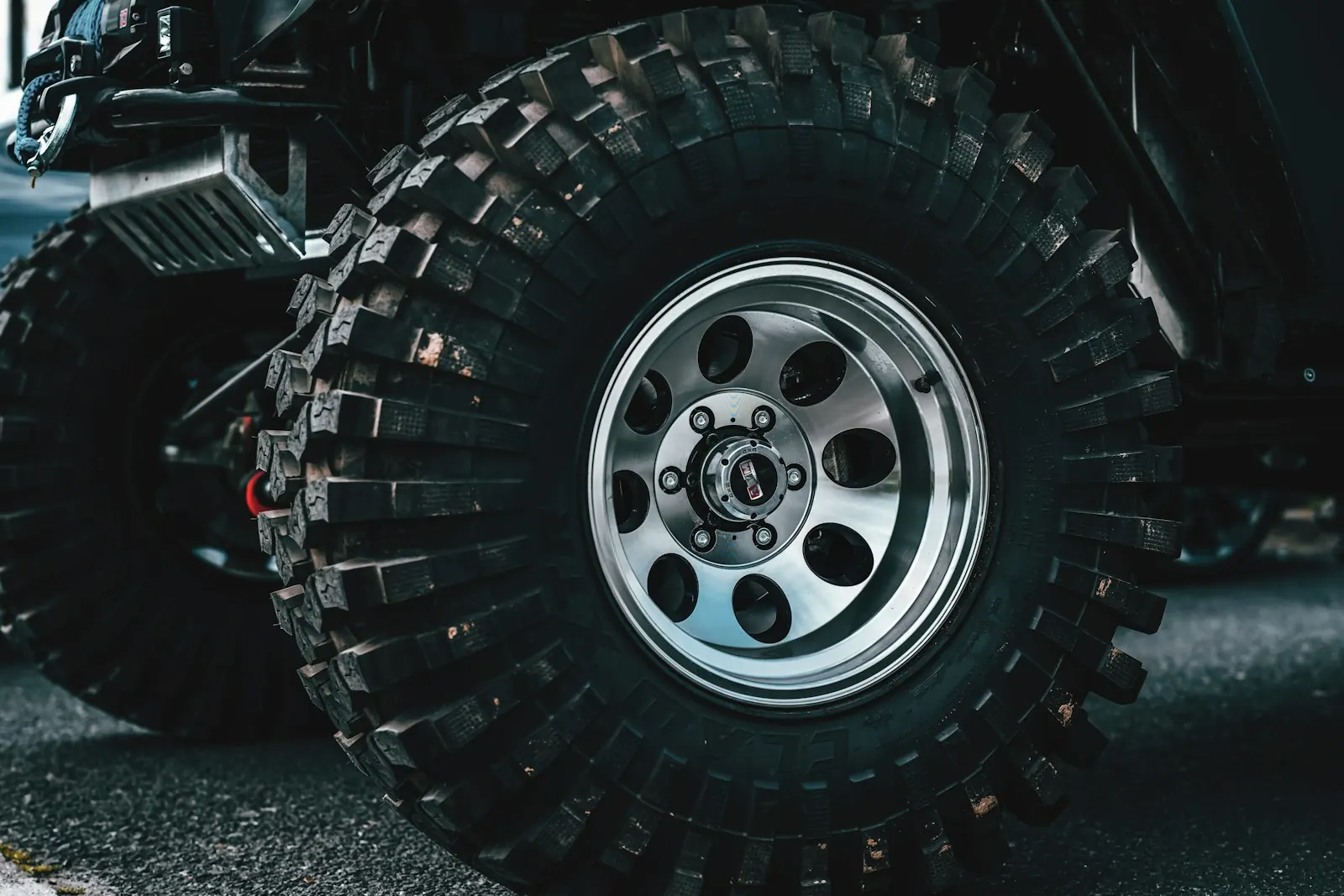
The TJ was designed around tires near 29 to 31 inches: the Sport rolled on 225/75R15 (about 28.9 inches) and the Rubicon on 31x10.50R15. Moving to 35x12.50R15 adds about 6 inches of diameter, roughly 21% over stock, and more than a third in weight per corner. Every other component feels it: the engine sees a taller effective gear ratio, the axle shafts and U-joints see higher loads, the steering and brakes work harder, and the fenders have to make room. None of this is a reason to avoid 35s. It is the honest picture before you spend money.
Lift height and fitment. A 35x12.50 will not clear a TJ at 2 inches, and 2.5 inches only works with heavy trimming and a rig that is not flexing much. For a Jeep that sees trail use, the realistic target is 4 to 5 inches of lift, plus cutting the front and rear fender flares back, trimming the front bumper corners and the bump-stop pockets, and adjusting the steering stops so the tire stays off the control arms and fender at full lock. Trail-use builds that retain stock-length bump stops, set the front end up with long control arms (long-arm lift guide), and often trim the rear tub corner. If you do not want to cut metal, 33x12.50R15 is the largest size that clears at 3 to 3.5 inches with little or no trimming.
Wheel choice. The TJ's 5x4.5-inch bolt pattern (5x114.3) and 15-inch wheel size are the most common trail setup, so 35x12.50R15 tires are widely stocked and the wheel catalog is deep. For a 15x8-inch wheel, 3.75 to 4 inches of backspacing keeps the tire off the control arms and the steering linkage at lock. Less backspacing pushes the tire outward and improves clearance on the inside, but it also pushes the tread beyond the fender, and some states regulate tire coverage. The wheel guide goes through offsets, and the beadlock guide covers the heavier option for low-pressure rocks.
Tire choice. The listed tires are typical of what Jeep owners run. Mud-terrains such as the BFGoodrich KM3 and Nitto Trail Grappler give the most bite on loose or wet trails and are loud on pavement. An all-terrain like the BFGoodrich KO2 is quieter, wears better, and holds up well in the rocks with a thick sidewall. The Cooper STT Pro is a deeper, more aggressive mud pattern. A 35x12.50R15 weighs very roughly 75 to 90 pounds per tire depending on the model and load range, so each wheel and tire assembly is a heavy lift, and five assemblies including a spare add serious mass to a bumper-mounted carrier (check your spare carrier rating and the rear bumper guide).
Gearing. At stock ratios of 3.07 or 3.73, depending on engine and options, a 35-inch tire pulls the effective gearing so tall that a 4.0L engine labors in top gear and lacks low-end power. The standard answer is 4.88 for a manual transmission and 5.13 for an automatic. The regear guide has the process and the cost: roughly $1,200 to $2,500 for both axles with a shop doing the work. Skipping the regear means a sluggish Jeep, worse fuel economy, and a transmission that hunts between gears, and many owners end up doing it six months later.
Speedometer. A 35-inch tire alone makes the speedometer read about 20% slow, which means the Jeep is going far faster than the dial shows. Regearing at the same time pulls this in the other direction: going from 3.73 to 4.88 with 35s makes the speedometer read about 8% fast. In both cases the number on the dial will be wrong, and you will need a calibration programmer or a speedometer corrector. Check with a GPS app before you trust it for speeding tickets or mileage.
Axles and drivetrain. The Dana 30 front with stock shafts and the Dana 35 rear are the limiting parts. A 35 with a locker or on a hard trail loads the Dana 35's C-clip axles and the Dana 30's inner shafts beyond what they were designed for. Budget for chromoly shafts (chromoly shaft guide) at minimum, and consider a rear Dana 44 swap (Dana 44 rear guide) if you wheel hard. A Dana 35 failure on a trail is a tow and a $1,000 repair. See Dana 35 failures for what goes first.
Steering and brakes. Taller, heavier tires put more load on the tie rods, the drag link, and the steering box. Plan on a heavier tie rod and drag link, and a good steering stabilizer. The stock brakes are marginal with 35s; the front pad guide covers a pad upgrade, and a larger-diameter caliper or a four-wheel-disc swap is the next step if you drive in mountains.
Real total cost. Five tires mounted and balanced: $1,100 to $1,700. Lift kit: $1,000 to $2,500. Regear: $1,200 to $2,500. Wheels: $600 to $1,200 for a set of five. Axle shafts: $500 to $1,200. A conservative total is $4,500 to $9,000, and the tires are about one-fifth of it. That is the number to plan around when someone says the plan is only to move up to 35s.
Costs and sources. Tires: $245 to $280 each (pricing in the parts list), $1,100 to $1,700 for five mounted. Wheels: $600 to $1,200. Lift: $1,000 to $2,500. Regear: $1,200 to $2,500. Shafts: $500 to $1,200. Budget the whole system, not the tire, before you start. If the budget is tight, 33-inch tires with the mid-lift fit with far less modification and are a more forgiving first step.
Steps
- Confirm lift height. Plan on 4 inches or more; with less, expect rubbing at full flex and decide whether to trim before you buy tires.
- Check your wheels for backspacing. 3.75 to 4 inches on a 15x8 wheel is the working range for 35s.
- Mount and balance the tires on a bead breaker and balancer rated for the load range; a 35x12.50 on a standard machine can cause balance issues, so ask the shop.
- Install the wheels with the Jeep on stands and torque the lug nuts to 95 ft-lbs in a star pattern.
- Lower the Jeep and turn the steering lock to lock, then have a helper compress each corner by hand or with a jack. Mark every contact point with chalk.
- Trim the contact points with a utility knife, nibbler, or cut-off wheel on plastic liner and flare edges; use a bump-stop extension before cutting metal.
- Adjust the steering stops if the tire contacts the control arm or frame at full lock.
- Re-torque the lug nuts after 50 miles.
- Schedule the regear, calibrate the speedometer, and check the axle shafts, the steering, and the brakes before taking the Jeep on a trail.
Why it works
- 35 inches is the most common serious trail size for a TJ, so fitment advice and parts are plentiful.
- 15-inch wheels are stock fitment, so there is no adapter or special wheel size.
- Meaningful ground clearance and approach-angle gain over 31s and 33s.
- BFG KM3 and KO2 both have long trail records and broad availability.
Trade-offs
- Gears at both axles are non-negotiable, adding $1,200 to $2,500.
- 35s overload the Dana 35 rear and the Dana 30 front shafts; plan on chromoly shafts or an axle swap.
- Fuel economy drops 2 to 4 mpg and acceleration suffers, especially on the 4.0L automatic.
- A 35 will not clear without cutting at lift under 4 inches, and the cuts are permanent.
- The speedometer will be wrong until you correct it.
Tools required
- torque wrench
- floor jack
- jack stands
- lug wrench
Parts
| Part | Vendor | Est. price |
|---|---|---|
| BFGoodrich Mud-Terrain T/A KM3 35x12.50R15 LT (E-rated) | BFGoodrich | ~$280 |
| BFGoodrich All-Terrain T/A KO2 35x12.50R15 LT (C-rated) | BFGoodrich | ~$270 |
| Nitto Trail Grappler M/T 35x12.50R15 (E-rated) | Nitto Tire | ~$265 |
| Cooper STT Pro 35x12.50R15 LT (E-rated) | Cooper Tires | ~$245 |
Sources
- JeepForum — 35s on a TJ: Lift Requirements and Trimming Guide
- BFGoodrich KM3 Product Page
- 4WD Hardware — TJ Tire Fitment Guide
Related
- Budget Lift Kit — Coil Spacers and Entry Springs (≤$600)
- Mid-Tier Lift Kit — 3"–4" Spring Lift ($600–$1,500)
- Wheel Selection for the TJ — Steel, Alloy, and Beadlock
- Re-Gearing the TJ — 4.56, 4.88, and 5.13 Ratios
- All Jeep Wrangler TJ guides & tools
- Browse the full DIY database
Written and maintained by an AZ wheeler and driveway wrencher. How we source guides. Always cross-reference your factory service manual — modifications affect vehicle safety and warranty. Work at your own risk.