JK vs JL Wrangler: What Actually Changed Off-Road (and What Got Worse)
If you are buying stock and wheeling stock, the JL Rubicon is the more capable vehicle — 10.9 inches of ground clearance against the JK Rubicon’s 10.2, 2.4 degrees more breakover angle, 33-inch tires and 4.10 gears instead of 32s, and with the eight-speed automatic a published crawl ratio of 77.2:1 where the JK’s five-speed worked out near 59:1. If you are buying something to build, the JK gives you more capability per dollar, because the platform is a decade older, the parts are everywhere, and what you save on the Jeep goes into axles, gears and tires.
The JL did not win every column, and the places it lost are the ones nobody puts in a comparison video. Jeep’s own published Rubicon figures give up 3.4 degrees of departure angle — 37.0° against the JK’s 40.4° — so the rear bumper and spare carrier find the ground earlier coming off an obstacle. Both Rubicon ring gears got smaller: 210 mm front against 216, 220 mm rear against 226. And a base JL Sport with an open differential carries a 200 mm rear axle where a 2018 JK Sport came with a 226 mm Dana 44. Newer and stronger are not the same claim, and the axle spec sheet is where they come apart.
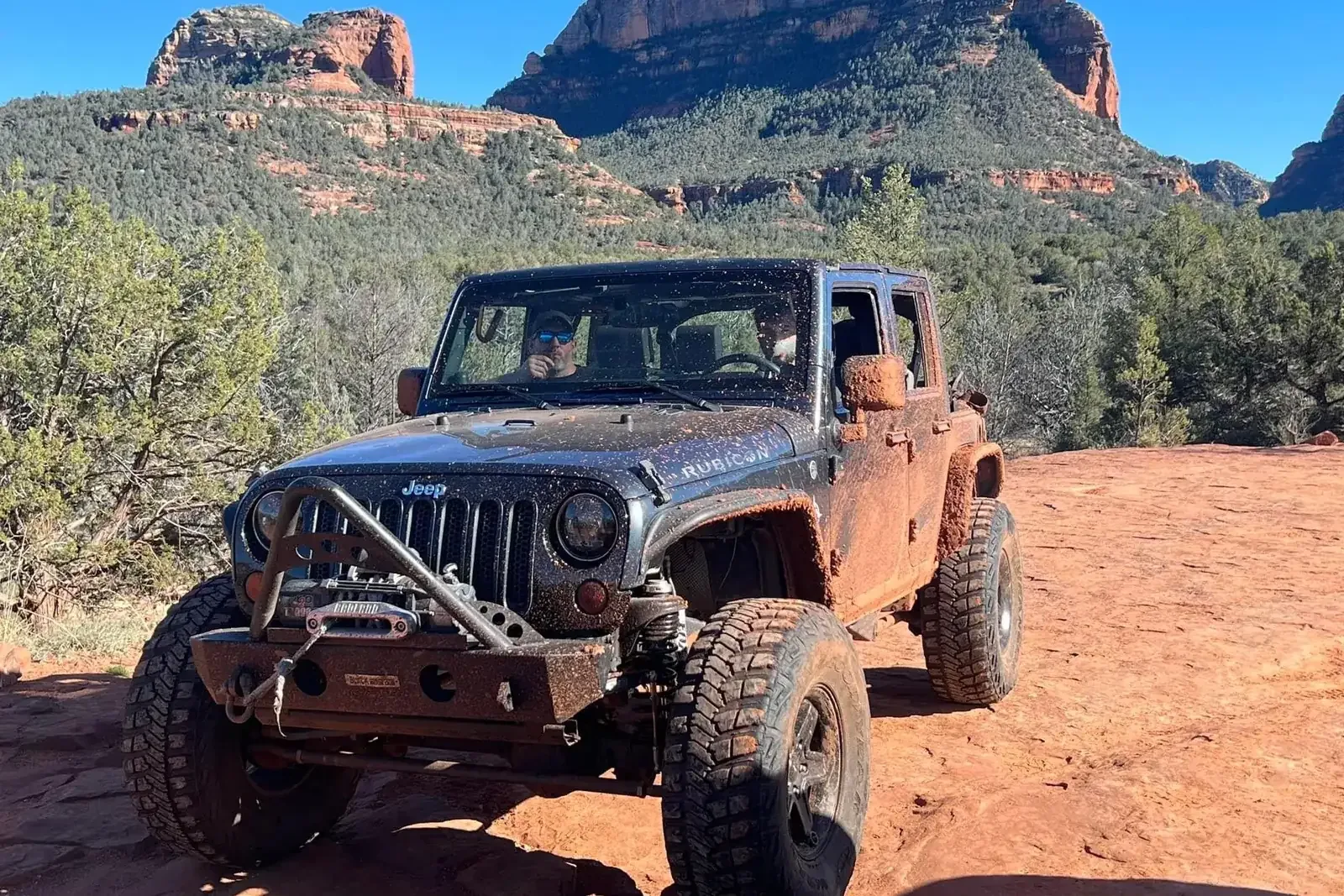
Three real changes, in order of how much you will feel them. One: the automatic crawl ratio went from roughly 59:1 to 77.2:1, which is the biggest functional upgrade on the list because most Wranglers are automatics. Two: the JL gained 0.7–0.8 inches of clearance and 2.4 degrees of breakover and lost 3.4 degrees of departure, so it is better getting over things and worse getting off them. Three: the axles moved sideways rather than up — bigger shafts, smaller ring gears, and a parts catalogue that does not carry over from the JK. Everything else — the full-time Selec-Trac option, the forward trail camera, the four-bolt windshield, the factory 35-inch Xtreme Recon package — is real but secondary. And the JL’s price premium over a JK is almost always larger than the capability gap it buys.
The geometry: better over obstacles, worse coming off them
These are Jeep’s published Rubicon figures. Read the direction of each change rather than the decimal, because Jeep quotes geometry by trim and door count and the numbers shift when it does.
| Rubicon spec | JK (2007–2018) | JL (2018–present) |
|---|---|---|
| Approach angle | 44.3° | 44.0° — effectively unchanged |
| Breakover angle | 25.4° | 27.8° — up 2.4° |
| Departure angle | 40.4° | 37.0° — down 3.4° |
| Ground clearance | 10.2″ (2-door) / 10.1″ (4-door) | 10.9″ |
| Wheelbase | 95.4″ / 116″ | 96.8″ / 118.4″ |
| Factory tire | 32″ BFG Mud-Terrain | 33″ |
| Curb weight (range, all trims) | 3,879–4,341 lb | 3,948–5,103 lb |
The clearance and breakover gains are the ones you feel on a ledge or a crest — 2.4 degrees of breakover with 0.7 inches more belly height is a meaningful change in what the Jeep will straddle without high-centring, and it arrives despite a wheelbase that grew 1.4 inches on the 2-door and 2.4 on the 4-door. Growing the wheelbase and improving breakover at the same time takes real work.
The departure angle is the cost. Three and a half degrees sounds academic until you are backing down off a rock shelf and the rear bumper is the first thing to touch. If your wheeling is steep, technical, and involves reversing out of things, that is the one spec in the table that will annoy you — and it is also the one most easily fixed, because an aftermarket rear bumper that tucks and loses the factory overhang is a common early JL purchase for exactly this reason.
One more thing worth saying because the marketing obscured it: the JL uses aluminum doors, hood, fenders and windshield frame and a magnesium swing gate, and it is still heavier than the JK. The aluminum bought back weight that content, structure and sound deadening added. It did not produce a lighter Jeep, and if anyone tells you the JL is the lightweight option, the curb weight row above is the answer.
The crawl ratio is the change that actually matters
Both Rubicons use the same 4:1 Rock-Trac low range and the same 4.10 axle ratio, so the whole difference lives in first gear. Jeep publishes 84.2:1 for a JL Rubicon with the six-speed manual and 77.2:1 with the eight-speed automatic. The JK Rubicon’s published figure was 73.1:1 with its six-speed manual. Its five-speed automatic was never advertised with a crawl ratio, and the reason is visible in the arithmetic: the W5A580’s 3.59:1 first gear through 4:1 and 4.10 gives roughly 59:1.
That is the comparison most buyers are actually making, because most Wranglers sold were automatics. An automatic JL Rubicon crawls about 30 percent deeper than an automatic JK Rubicon. In the driveway that is a number. On a steep rutted climb it is less brake-riding, less converter slip, and more of the vehicle creeping at the speed you chose rather than the speed it happens to fall into. It is the one difference you will notice inside ten minutes of driving both, and it is the one that does not show up in a side-by-side you read on your phone.
If you are weighing a JK against a JL and planning to put larger tires on either one, run both through our gear ratio calculator before you decide. A JK with 4.56 or 4.88 gears and 35s recovers most of that crawl ratio gap for the cost of a re-gear, which is real money but less than the platform premium.
The axles went two directions at once
This is the section that surprises people. Dana’s AdvanTEK naming is literal — the number is the ring gear diameter in millimetres — which makes the comparison unusually legible, and unusually awkward for the newer Jeep.
| Position | JK | JL |
|---|---|---|
| Sport / Sahara front | Dana 30, 186 mm | Dana 30 M186, 186 mm — same |
| Sport / Sahara rear | Dana 44 / Super 44, 226 mm | M200, 200 mm with an open diff; M220 (220 mm) with Trac-Lok |
| Rubicon front | Dana 44, 216 mm, 30-spline shafts | M210 wide track, 210 mm, 32-spline |
| Rubicon rear | Dana Super 44, 226 mm, 32-spline | M220, 220 mm, 32-spline |
Do not read that table as “the JL has weaker axles,” because ring gear diameter is one input among several. Shaft diameter and spline count, tube wall thickness, housing design and knuckle geometry all matter, and the JL’s front shafts went up to 32-spline while the housings were redesigned. What the table really says is that Jeep moved the weak point rather than removing it — stronger shafts, slightly less ring and pinion. For a stock Rubicon on 33s that is academic. For a Rubicon on 37s and heavy bumpers it is a live argument, and both platforms break parts at that end of the scale.
Two consequences are not arguable, though. First, nothing carries over. JK Dana 44 gears, lockers and shafts do not fit a JL, which means a JL re-gear is its own parts list at its own price, with a smaller pool of vendors and no salvage-yard supply. Second, a non-Rubicon JL has less rear axle than a non-Rubicon JK did. A 2018 JK Sport came with a 226 mm Dana 44 out back; a JL Sport with an open differential gets a 200 mm M200. If you are shopping entry trims with plans, that single line should change which one you look at — and note the escape hatch: a JL ordered with Trac-Lok got the 220 mm M220 instead, so read the build sheet rather than the badge.
If you are not sure what is under the Jeep in front of you, our axle identification guide covers the visual tells, and when to re-gear has the arithmetic for either platform.
What the JL has that a JK cannot be given
A short, honest list. These are the things no amount of aftermarket spending puts on a JK.
Selec-Trac full-time four-wheel drive, available on Sahara. A two-speed case with a 2.72:1 low range and a centre differential you can leave engaged on wet pavement, which the JK’s part-time Command-Trac cannot do without binding the drivetrain. This is not a rock-crawling feature. It is a driving-to-the-trail-in-the-rain feature, and for anyone who lives with snow it is the most useful item on this list.
The Xtreme Recon package (2021 and later, Rubicon 4-door and 392): factory 35-inch BFGoodrich KO2s on 17×8 beadlock-capable wheels, a 1.5-inch suspension lift with matched shocks, and 4.56 gears already in the axles, for 12.9 inches of clearance, 33.6 inches of fording depth and 47.4° / 26.7° / 40.4° of geometry. The gearing is the point. A factory 35s package with the re-gear already paid for and the whole thing under warranty is the one configuration the aftermarket genuinely cannot replicate. Note that breakover improves less than the lift suggests — the package is 4-door only, so the long wheelbase eats part of the gain.
A forward-facing trail camera (2020 and later), which is more useful than it sounds the first time you approach a blind ledge alone, plus Selec-Speed Control for hill descent and ascent at a set crawl speed. A windshield that folds with four bolts instead of the JK’s full-frame removal. And engine options the JK never had: a 2.0-litre turbo four, a 3.0 EcoDiesel making 442 lb-ft, the 470-horsepower 392, and the 4xe plug-in hybrid.
What the JK still wins
Price, and it is not close. The same budget buys a JK two trims higher than the JL it would buy, and on a used lot that often means the difference between a JL Sport and a JK Rubicon — which is to say, between a Jeep with an open rear differential and a Jeep with two lockers, a disconnecting sway bar and a 4:1 case. If the question is “what will go furthest for the money,” that comparison ends the discussion before the spec tables start.
Then the aftermarket. The JK had its entire eleven-year run plus eight years since to accumulate parts, and the result is more vendors, lower prices, deeper used and takeoff supply, and far more documented build experience to borrow from. Fewer modules sit between you and a modification, too, which matters once you start touching wiring, lighting and bumpers. None of this makes the JK the better vehicle. It makes the JK the cheaper vehicle to make good.
One honest caveat on the JK side, because it changes which JK you should buy: the 2007–2011 3.8-litre V6 made 202 horsepower and 237 lb-ft, and it is the weakest engine in this comparison by a wide margin. Buy a 2012-or-later JK for the 3.6 Pentastar, which is the same family of engine the JL got. Then read up on the 2012–2013 cylinder head failure before you look at those two model years specifically, because it is a known fault with a known tell and the warranty extension has expired on every affected Jeep.
Death wobble is not a JK problem the JL solved
This needs saying plainly, because buyers assume the newer Jeep fixed it. It did not. Both the JK and the JL use a recirculating-ball steering box and a track bar locating the front axle laterally — the geometry death wobble lives in. The JL built its own long record of steering complaints and class-action filings, and Chrysler revised the factory steering damper in response. A revised damper masks a loose component; it does not tighten it.
Treat it as a maintenance item on either platform. A JL with 60,000 miles needs the same track bar, tie rod, drag link and ball joint inspection a JK of the same mileage needs, and a worn part behaves identically on both at the same speeds. If you are test-driving either one, get it to highway speed over a patched expansion joint before you talk money. Our JK death wobble guide covers the diagnostic order, and the underlying mechanism is the same on every solid-axle Jeep with this steering layout.
How to actually decide
Buying stock, wheeling stock, keeping it stock: JL Rubicon. Factory 33s, 4.10 gears, two lockers, a front sway bar disconnect, 10.9 inches of clearance and a 77.2:1 automatic crawl ratio, with nothing to buy and nothing to fabricate. If the budget reaches a 2021-or-later Rubicon, price the Xtreme Recon package honestly against doing 35s and 4.56 gears yourself — the factory version is frequently the cheaper path.
Buying to build: JK Rubicon, 2012 or later. Put the platform savings into gears, tires and a rear bumper, and you will arrive at a more capable vehicle than the JL you could have afforded instead. The aftermarket is deeper, the parts are cheaper, and there is less wiring and fewer modules standing between you and the work.
Buying a non-Rubicon either way: check the rear axle before anything else, because that is where the two platforms diverge most and where the badge tells you least. A JK Sport’s 226 mm rear is more axle than a JL Sport’s 200 mm one, unless the JL was ordered with Trac-Lok, in which case it has the 220 mm M220 and the comparison closes right up. Our JK buyer’s guide and used JL guide each have the inspection order for that platform.
What this looks like as a weekend
Drive both, and drive them properly. Find a steep rutted climb and take each one up it in low range with the transmission doing the work. The crawl ratio difference is the thing you will feel, and it is the thing no spec sheet communicates. Then get both to highway speed over rough pavement and listen to the steering. Then price the build you actually want on top of each — gears included, bumper included — and compare the totals rather than the stickers.
The honest conclusion is the one that gets left out of platform arguments: both of these Jeeps will go considerably further than most owners will ever take them. The JL is better out of the box and the JK is better per dollar, and the gap between them is smaller than the ten-year model-year jump implies. Whichever one ends up in your driveway, the limiting factor is going to be seat time, tire pressure and line choice — not the badge on the tailgate. Pick the one you can afford to use, and go use it.
Related guides
JL Rubicon geometry, crawl ratios, transfer case ratios, axle ratios, fording depth and aluminum/magnesium content from FCA’s official 2018 Wrangler press materials. Xtreme Recon figures from FCA’s 2021 package announcement. JK trim-by-trim ground clearance, wheelbase, curb weight, payload, towing and transfer case designations from Jeep’s published 2018 JK specifications. JK Rubicon approach, breakover and departure angles and factory tire size from the JK model record. Axle ring gear diameters compiled from Dana AdvanTEK designations (the number is the ring gear diameter in millimetres) and published Wrangler axle references; OEM and aftermarket listings disagree by a few millimetres on the JK Dana 44, and spline counts for JK front and JL front shafts come from owner teardown comparisons rather than factory documentation. The JK five-speed automatic crawl ratio is our own calculation from the W5A580’s 3.59:1 first gear through the 4:1 Rock-Trac and 4.10 axles, not a Jeep-published figure, and is labelled as such above. Jeep quotes off-road geometry by trim and door count, so treat single-decimal differences as direction rather than verdict.