33s and 35s on the JL: What Fits at What Lift, Rubicon vs Non-Rubicon
A JL takes 33s with little or no lift. A Rubicon can run 35s on stock height for road driving, but it rubs the inner fenders once it flexes off-road, so plan on about 2 inches of lift or bump stop spacers. A Sport or Sahara needs a lift and wheels with less backspacing, and the gears decide how the Jeep drives once the tires clear.
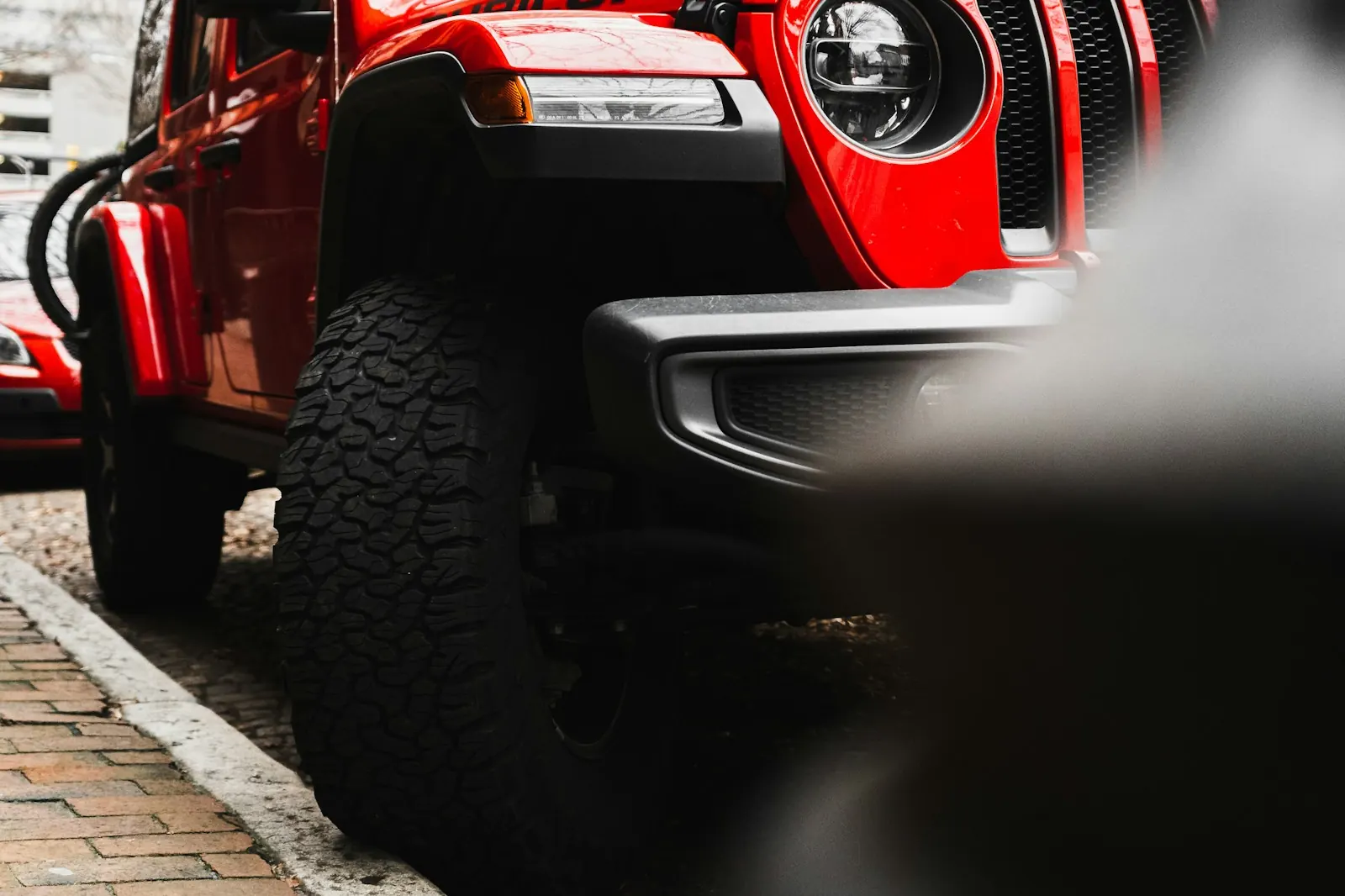
What fits at what lift
The factory starting point matters. ExtremeTerrain's door-placard list puts the Sport family on 245/75R17, the Willys on 255/75R17, and the Rubicon on 285/70R17. Performance Plus Tire measures those as about 31.5 inches for the Sport and 32.7 inches for the Rubicon, which is why the same 35 is a much bigger step on a Sport.
| Setup | 33s (285/70R17 class) | 35s (35x12.50R17 or LT315/70R17) |
|---|---|---|
| Rubicon, stock height | Factory size | Clears at ride height and most street driving. Touches the liner under hard compression and at full lock. |
| Sport or Sahara, stock height | Little to no modification, depending on wheel | Rubs. Needs bump stops and a wheel change at minimum. |
| 1.5 to 2 inches | Clean | Workable on a Rubicon. Rubicon Express markets its 2-inch kit for 35s on Sport and Sahara. |
| 2 to 2.5 inches | Clean | Quadratec's common range for 33s to 35s. |
| 3 to 3.5 inches | Clean | Quadratec calls this 35s with minimal rubbing. |
Jeep's own answer backs up the 2-inch figure. Driving Line reports Jeep saying 35s fit a Rubicon with no lift, but that off-road use calls for a 2-inch lift. In its test, 35x12.50R17 Nitto Ridge Grapplers on 17x9 wheels cleared at rest and pressed hard against the outside of the inner fenders when the Jeep articulated, worse at the front. Its fix was bump stop spacers at all four corners, which kept the height but gave up about 2 inches of up-travel.
Jeep sells the proof that a small lift is enough. The factory Xtreme Recon package pairs LT315/70R17 BFGoodrich KO2s with a 1.5-inch suspension lift, 17x8 beadlock-capable wheels and 4.56 axles, and the package includes swing gate reinforcement, so budget for what a 35-inch spare does to the tailgate. Performance Plus Tire says a current Rubicon 392 already ships on that 34.4-inch tire.
Two trims need their own caution. Performance Plus Tire puts a Rubicon 4xe about 2.1 inches short of a gas Rubicon's running clearance and treats bump stop extensions as required, and it calls the Sahara 4xe the biggest jump of any JL, where a lift is the plan.
Wheels and backspacing
Rub points on a JL are the outboard face of the front inner fender liner under compression, and the inner shoulder of the tire against the lower control arm or frame at full lock under load. Add the pinch seam and sway bar end links to the check list, per ThreePiece. Backspacing moves the tire between those two problems.
Published stock numbers disagree a little. Performance Plus Tire lists the Rubicon's 17x7.5 at about +37mm (roughly 5.7 inches of backspacing) and the Sport and Sahara's at about +44mm (roughly 6.0 inches). ThreePiece gives about +44 for 17x7.5 wheels without naming a generation. Measure yours if it matters; the wheel guide shows how.
- Bolt pattern: 5x127mm (5x5 inches), per Quadratec.
- Common 35-inch wheel: 17x9 at -12mm, about 4.5 inches of backspacing, per Performance Plus Tire. It also gives 4.5 to 5.0 inches, roughly -12 to 0 offset on a 17x9, as the range for a Rubicon.
- Sport and Sahara: these sit lower, so that source runs the tire further out.
- The cost of poke: the -12mm change moves the outer sidewall out about 2.6 inches. Buy the least offset change that solves the clearance problem.
- Spacers: Quadratec lists them as an alternative to new wheels for reaching the right backspacing. The spacer guide covers the trade-offs.
If you change wheels, the JL wheel guide covers moving the pressure sensors.
Gearing
You probably do not need gears for 33s on a Rubicon's 4.10s. Going to 35s on a 3.45 or 3.73 axle is where it starts to show. Performance Plus Tire reports automatics hunting on grades and holding the converter unlocked on 3.45s, with 4.10s tolerating 35s far better. It suggests 4.56 or 4.88 for towing, heavy loads, or large elevation changes.
Yukon Gear recommends 4.88 for a manual JL on 35s, which it puts a little over 2,000 rpm at 60 mph, and says 5.38 is not unusual for towing on 35s. It gives no ratio for automatics. Jeep's factory Xtreme Recon package runs 4.56 on the same 35-inch tire, so both ratios are defensible; the regear guide walks through the choice. ExtremeTerrain's chart shows the spread at 65 mph in a 1:1 gear on a 35: about 2,328 rpm on 3.73, 2,565 on 4.11, 2,845 on 4.56, and 3,045 on 4.88. Quadratec notes overdrive runs 15 to 30 percent below a chart like that, so read those numbers as relative.
Both axles change together. The JL regear guide has the process.
The speedometer goes wrong with the tire. Performance Plus Tire figures 32.7 to 34.7 inches as a 6 percent error on a Rubicon. From a Sport's 31.5 inches the same arithmetic gives about 10 percent. Driving Line corrected its test Jeep with a Tazer JL.
Not confirmed
- A manufacturer backspacing limit for a stock-height Sport on 33s. Sources say it depends on the wheel and give no number.
- Whether the 2-door and JLU rub differently. Most fitment data here is from 4-doors.
- A 35-inch price below about $417 each. This guide's cost range covers four 33s at the low end and five 35s at the high end, at Quadratec prices when written, with no lift, wheels, or gears. The BFGoodrich KO2 in 35x12.50R17 showed as no longer available there.
Steps
- Read the door placard, and confirm your axle ratio and whether the Jeep is a 4xe.
- Decide the size. Mud-terrains measure wider, which is why those owners report more rubbing, so check the tire's listed width.
- Set the lift or bump stops first, and re-center the axle if the lift calls for it. See the JL track bar guide.
- Mount one tire and wheel on the front and test before buying the set, if your shop allows it.
- With the Jeep safely on stands, cycle the suspension as far as you safely can, then turn lock to lock on the ground. Mark every contact point with chalk.
- Trim the plastic liners or add bump stop spacers before you cut anything else.
- Tighten the lugs to the wheel maker's number. Northridge4x4's factory chart lists 130 ft-lb for the factory 22mm lug on a JL or JT; check it against your owner's manual, and recheck after the first drive.
- Correct the speedometer, then schedule gears if the Jeep hunts on grades.
Why it works
- 33s are close to a bolt-on swap on most trims.
- Jeep's factory 35-inch package shows a small lift and 4.56s work.
- Bump stops can save a Rubicon from a full lift, if you accept less up-travel.
Trade-offs
- 35s on a stock-height Sport or Sahara rub without both bump stops and new wheels.
- Lower backspacing adds poke, and bump stops cost up-travel.
- 35s cost about $417 to $432 each at the listings checked, before gears.
Tools required
- floor jack
- jack stands
- torque wrench
- tape measure
- chalk or paint marker
Parts
| Part | Vendor | Est. price |
|---|---|---|
| BFGoodrich All-Terrain T/A KO2 LT285/70R17 (each) | BFGoodrich | ~$268 |
| Toyo Open Country A/T III 35x12.50R17LT, load range E (each) | Toyo Tires | ~$417 |
| Nitto Ridge Grappler 35x12.50R17LT (each) | Nitto | ~$432 |
Sources
- Tested: What It Takes to Run 35s and No Lift on the Rubicon JL (Driving Line)
- Will 35s Fit a Wrangler JL Without a Lift? (Performance Plus Tire)
- 2022 Wrangler Willys with Xtreme Recon package (Stellantis)
- Jeep official details on the Wrangler Rubicon Xtreme Recon package (Mopar Insiders)
- Jeep Lift Kits Explained (Quadratec)
- Aftermarket Jeep Wheels FAQ (Quadratec)
- How To Put Bigger Tires On Your Jeep (Quadratec)
- Ultimate Tire Size Guide for Jeep Wranglers (ExtremeTerrain)
- Gear Ratio and Tire Size Chart (ExtremeTerrain)
- Re-Gearing a Jeep JLU Wrangler With 35-Inch Tires (Yukon Gear)
- Can You Run 35s on a Jeep Wrangler? (ThreePiece)
- Rubicon Express Releases JL Wrangler Lift Kit (The Shop)
- Jeep Bolt Sizes and Torque Specs Chart (Northridge4x4)
- Toyo Open Country A/T III 35x12.50R17LT listing (Quadratec)
- Nitto Ridge Grappler 35x12.50R17LT listing (Quadratec)
- BFGoodrich KO2 size table (Quadratec)
Related
- Running 37" Tires on the JL — Rubicon vs Non-Rubicon Fitment
- Wheel Selection for the JL — Steel, Alloy, and Beadlock
- Budget Lift Kit — Spacers and Entry Springs (≤$600)
- Mid-Tier Lift Kit — Spring Lift with Geometry Correction ($600–$2,000)
- Re-Gearing the JL — 4.56 and 4.88 Ratio Selection
- Front Track Bar Upgrade — Lifted JL Wrangler
- Wheel Spacers — 1.25" to 1.5" for the JL Wrangler
- All Jeep Wrangler JL guides & tools
- Browse the full DIY database
Related tools
- Lift & Tire Matrix — what tire fits at each lift height, with rubbing notes and gearing
- Wheel Offset & Backspacing Visualizer — see where a wheel sits before you buy it
- Tire Pressure / Airdown — trail pressure for your tire size and terrain
Written and maintained by an AZ wheeler and driveway wrencher. How we source guides. Always cross-reference your factory service manual — modifications affect vehicle safety and warranty. Work at your own risk. Spot an error? Send a correction and it gets fixed at the source.