JK vs JL Flex: What the Measured Numbers Say About Control Arms, Lift, and Articulation
Stock for stock, a JL Rubicon flexes about 100 points more than a JK Rubicon on MetalCloak's CTI trailer — 640 to 540, roughly ten inches of total wheel travel. Put the same 3.5-inch kit under both and the gap closes to nothing: a JKU and a JLU on the Game-Changer 3.5 with 37s both score 770. The JL's advantage is its factory shocks and arm geometry, and it lasts exactly as long as those parts are the limiter. Nobody has published a controlled, same-kit test at 2.5 or 4.5 inches; this guide lays out every number that does exist, what it measures, and what it means for a JK owner choosing a lift.
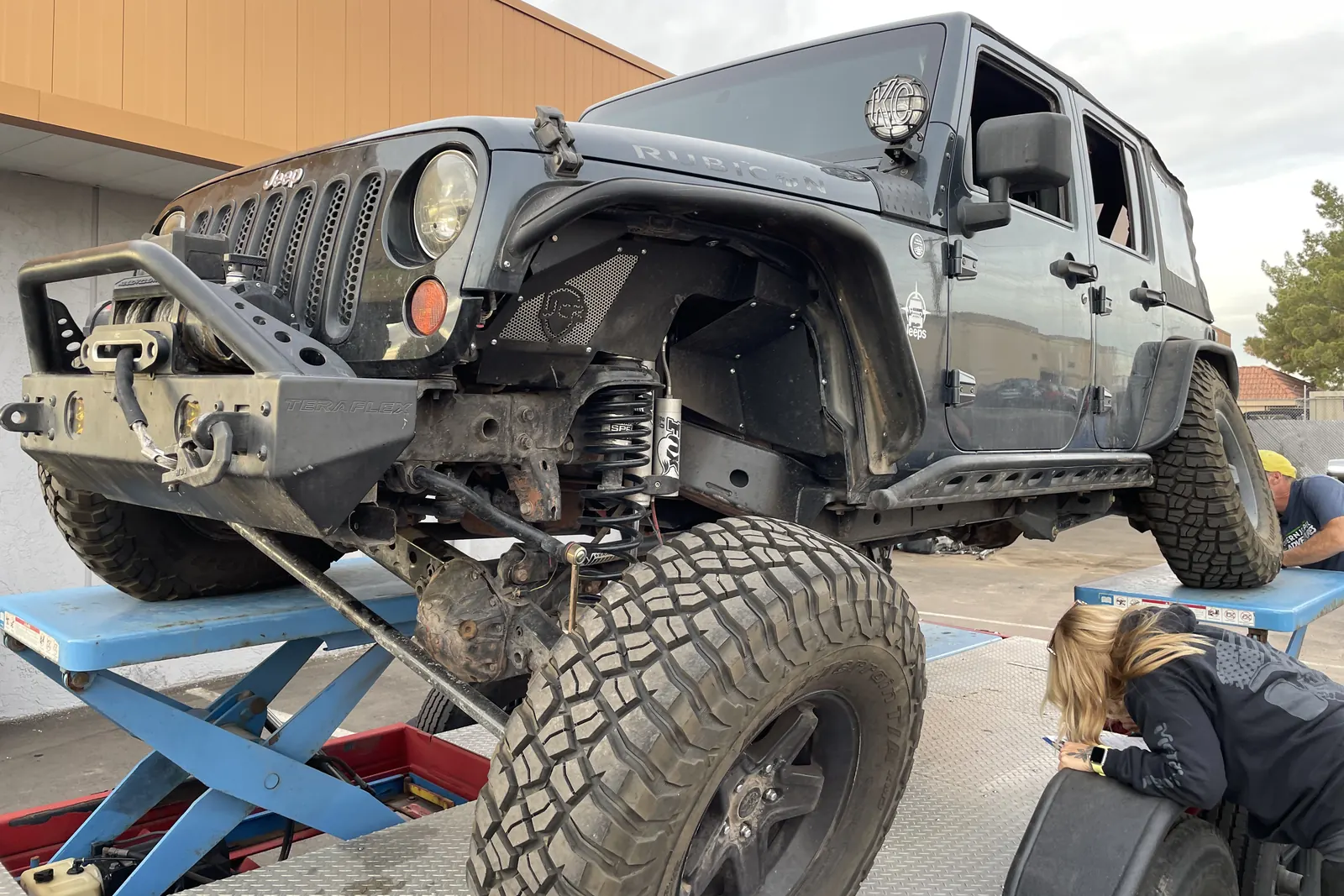
The question "does the JL flex more than the JK" gets answered with a shrug and a forum link. The honest version takes four tables, because the answer changes depending on whether you measure stock trucks, lifted trucks, or the same kit on both platforms — and because half the scores floating around were taken on different ramps and cannot be compared at all. Everything below is sorted by method, with the sources attached.
How flex is measured, and why half the internet's scores are useless
Two numbers show up in every flex argument, and they are not interchangeable.
RTI (Ramp Travel Index) drives one front tire up a fixed-angle ramp until another tire lifts, measures the distance traveled up the ramp, divides by wheelbase, and multiplies by 1,000. It measures how far one corner can droop while the opposite corner compresses. It is cheap, universal, and sensitive to the ramp angle: the same rig scores 1,033 on a 20-degree ramp, 836 on 25 degrees, and 706 on 30 degrees, per MetalCloak's own scaling data. A score without a ramp angle is a story, not a measurement. Every RTI figure in this guide is 20 degrees or has been converted to it.
CTI (Corner Travel Index) is MetalCloak's trailer: it lifts each corner independently, records travel at all four, and sums them. It captures the total articulation envelope rather than the first tire to lift, runs at 15 psi, and has a ceiling of 900. MetalCloak has run thousands of Jeeps across it with one rig and one method, which makes CTI the most comparable dataset that exists for Wranglers.
The two scales do not convert to each other. A JKU that posts 982 on a 20-degree ramp and 770 on the CTI trailer is the same truck measured two ways.
Stock Rubicon Unlimited: JK vs JL
| Measurement | JKU Rubicon | JLU Rubicon | Delta |
|---|---|---|---|
| RTI, 20°, sway bar disconnected | 687 (Edmunds, 2012) | 693 (Four Wheeler); 718 and 724 in other 20° tests | +5% |
| RTI, 20°, sway bar connected | ~518 | ~523 | none |
| CTI, 15 psi | 540 | 636–640 | +100 |
On the ramp, the stock JLUR is 30 to 40 points ahead of a JKUR with the sway bar off and identical with it on — the IH8MUD compilation and the Edmunds JK test agree within the noise of two different test days. Jeep's own 822 figure for the JL is the two-door, which is 20 inches shorter in wheelbase and always scores higher.
The CTI trailer tells a bigger story. When MetalCloak put a stock 2018 JL Rubicon and a stock JK Rubicon on the same trailer, the JL scored 640 against the JK's 540 — about ten inches more total wheel travel across four corners. A stock JLU owner who posted 636 was told by MetalCloak's crew that his number sat where JKs land after an AEV, Rubicon Express, or Teraflex 2.5-inch kit. The JL ships with roughly a 2.5-inch kit's worth of articulation built in, and the sources of that are the longer-stroke factory shocks and the control arm geometry covered below.
Same kit, both platforms: the only fair comparison
Owner-reported CTI scores on the MetalCloak Game-Changer 3.5 are the closest thing to a controlled test, because the trailer is one rig and the kit is one design. Everything here is 37-inch tires at 15 psi.
| Setup | CTI | Per-corner travel |
|---|---|---|
| JKU Sport, Game-Changer 3.5, 37s | 770 (710–730 at street pressure) | — |
| JLU Willys, Game-Changer 3.5, 37s | 770 | 20.5 in front, 18.5 in rear |
| JLU Willys, JKS J-Konnect 3.5, 35s (same truck, before the swap) | 680 | ~17 in per corner |
| JLU Rubicon, MetalCloak 3.5 | 880 | — |
| JL Rubicon 2-door, Rock Krawler 3.5 X Factor, M95 shocks, no bump stops | 850 | — |
The JKU Sport on the Game-Changer and the JLU Willys on the same kit both land on 770. The JL's 100-point stock advantage is gone, because the kit replaced the parts that created it. Both trucks are now limited by shock length, bump stop height, and how far the coils stay seated — and the kit sets all three. The JL owner noted he had an inch of rear bump stop left to remove, and that the kit's instructions call for at least one bump stop puck on the JL because the front driveshaft contacts the 48-volt battery box on eTorque engines, or the fuel tank skid on others, at full compression. The JL gives a little travel back to packaging the JK never had.
The spread inside the JL column is instructive. A JLU Rubicon on the same MetalCloak 3.5 posted 880, close to the trailer's 900 ceiling. A two-door on the Rock Krawler 3.5 with Skyjacker M95 shocks and no bump stops posted 850 with the shocks topping out on droop, then went six inches further up a 30-degree ramp after swapping to the Game-Changer with two-inch bump stops. Two-door versus four-door, which shocks, and whether the bump stops were trimmed move the score by more than the JK-versus-JL platform difference does.
What a lift does to a JK's flex, by height
The best single dataset for lifted JKs is a 2008 Off Road Evolution ramp day: 22 JKs, one 30-degree ramp, one afternoon, scores converted to 20 degrees. Measurements were taken at axle center with a plumb bob rather than at the tire, so add roughly 10 percent to compare against a conventional score. Everyone ran street pressure.
| JK Unlimited setup | RTI (20° equivalent) |
|---|---|
| Stock X | 624 |
| Stock Rubicon | 630 |
| 2 in OME, 33s | 744 |
| 2.5 in TeraFlex, 33s | 756 |
| 3 in BDS, 34s | 781 |
| 3 in TeraFlex, 35s | 769 |
| 3 in Skyjacker, 33s | 561 |
| 4 in Full Traction + Fox, 35s | 731 |
| 4 in Skyjacker, 35s | 744 |
| 4 in Rancho long-arm, 37s | 775 |
| 4 in Full Traction, 37s | 668 |
| 4 in TeraFlex long-arm + EVO front coilovers, 37s | 863 |
| 4.5 in EVO coilovers + rear Lever, 37s | 939 |
Three things fall out of that afternoon's numbers. A 2-to-3-inch coil kit is worth 120 to 150 points over stock on a JKU. The 4-inch bolt-on kits on 35s and 37s scatter from 660 to 775 and do not beat the 2.5-to-3-inch kits, because a taller spring with the same shock and bump stop package gains nothing in travel. Only coilovers or the EVO Lever broke 850. Lift height and flex are not the same axis.
Later single-truck scores fill in the top of the range: a JKU on the Game-Changer 3.5 ARB edition ran 982 on a 20-degree ramp, and a two-door JK Rubicon on TeraFlex 2.5-inch coils with the stock Rubicon shocks on adapters scored 812 — no better than stock numbers the owner had seen, with the front sitting on the bump stop and the rear out of shock. Stock shocks on a lift are the most common reason a lifted Jeep flexes like a stock one.
What a lift does to a JL's flex
The one controlled test is TrailRecon's 2020 Moab comparison: six new, identical JLU Rubicons, six kits, the same 37s, flex measured as per-corner tire lift at full articulation. The install-and-measurement write-up ranks the Rock Krawler 3.5 X Factor first by a wide margin, the Icon 2.5 Stage 1 second, and the RockJock 4-inch with Fox shocks at the back — a 4-inch kit outflexed by a 2.5-inch kit, for the same reason the JK ramp day showed: shock length. The Teraflex 3.5 ST3 with Falcon 3.3s, AEV 2.5 DualSport RT, and Dynatrac 2-inch filled the middle.
Combined with the CTI data above, the JL pattern is: stock 636–640, mid-arm 3.5-inch kits 770–880 depending on shocks and bump stops, and the trailer ceiling of 900 within reach on a Rubicon with a well-set 3.5.
Control arm lengths: the geometry behind the numbers
Flex headlines sell kits, but the arm geometry is what you live with on the road every day. These are the factory center-to-center lengths, from Teraflex's published "factory length" per arm position and confirmed by an owner's tape on a 2024 Rubicon X. The Rubicon X runs the same arms as every other JL.
| Arm | JK Rubicon, stock | JL Rubicon X, stock | JKU + Teraflex Alpine IR at 2.5 in (set length) |
|---|---|---|---|
| Front lower | 22 5/8 in | 24 in | 23 1/8 in (+1/2) |
| Front upper | 18 3/4 in | 20.185 in (512.7 mm) | 18 7/8 in (+1/8) |
| Rear lower | 19 3/4 in | 19 3/4 in | 20 1/2 in four-door, 20 1/8 in two-door |
| Rear upper | 17 7/16 in | 17.425 in (442.6 mm) | 18 1/2 in four-door, 18 5/16 in two-door |
Teraflex lists the JK front lower at 22-5/8 inches and the JL front lower at 24 inches; a Rubicon X owner's tape agreed. Rock Krawler's install manuals cross-check within an eighth: their JK front lower sets to 23 inches at 2.5 inches of lift, their JL front lower to 24-1/4.
The platform difference is all in the front. JL front arms are 1-3/8 inches (lower) and 1-7/16 inches (upper) longer than the JK's. The rear arms are the same length to within a sixty-fourth. That is the entire geometric case for the JL's better ride, and it is a real but modest one.
The Alpine IR set lengths, from Teraflex's own install sheet, show what a 2.5-inch lift asks of the arms. Front lower grows half an inch and the front upper an eighth; that 3/8-inch difference across roughly eight inches of axle-side mount spacing rotates the front axle back about 2.7 degrees — the caster the lift took. The rear is the mirror image: the upper grows more than the lower, rotating the pinion back up toward the driveshaft. Both arms growing together pushes the axle back out to center in the wheel well after the arc pulled it in.
Arm angle: what the lift costs, in degrees
Stock arm angles are not published for either platform. What is certain is the change a lift adds, because a short-arm kit keeps the factory mounts and raises the frame end by the lift amount:
| Arm | JK, Alpine IR, 2.5 in lift | JL, stock-length arm, 2.5 in lift |
|---|---|---|
| Front lower | +6.2° | +6.0° |
| Front upper | +7.6° | +7.1° |
| Rear lower | +7.0° | +7.3° |
| Rear upper | +7.8° | +8.3° |
The arithmetic is the arcsine of lift over arm length, and the stock starting angle shifts these by less than a tenth of a degree. The JL's longer front arms buy it a quarter-degree per 2.5 inches. The real platform difference is the stock starting angle, which JL owners describe as longer and more parallel than the JK's — the JL starts flatter and so stays flatter at the same lift. Nobody has put a number on it. Two tape measurements per arm would: frame-bolt center to the ground and axle-bolt center to the ground on level pavement at ride height; the difference over the arm length is the angle.
How the geometry shows up on the road and the trail
Arm length and angle act through four mechanisms, and every symptom traces to one of them.
The arc. An arm swings on a circle around its frame bolt. The steeper it sits, the more the axle moves fore and aft for every inch it moves up — the ratio is the tangent of the angle. Each 2.5 inches of lift on short arms adds about 0.11 inch of fore-aft walk per inch of wheel travel, close to an inch over a full stroke. Rubber bushings absorb that in shear, and you feel it as sharper edges on expansion joints and a busy front end on washboard. The JL's longer front arms sweep a flatter arc, which is part of why it rides better at the same lift. Long arms flatten it further; the short-arm versus long-arm guide covers where that trade is worth making.
Rotation through travel. Uppers are shorter than lowers, so the axle rotates as it travels. The front loses caster as it droops and gains it in compression; the rear pinion does the same. A JK on fixed-length arms loses roughly a degree of caster per inch of lift, which you feel as wander, weak return-to-center, crosswind sensitivity, and the on-ramp to death wobble. Adjustable arms fix it by length, as the Alpine IR set lengths above show. The JL's longer arms lose less caster per inch, which is why the Mopar 2-inch JL lift gets away with lower arms only a quarter-inch longer than stock, and why a 2.5-inch JL kit on fixed arms still needs an alignment check rather than an assumption.
Instant center. Where the upper and lower arm lines converge sets how much the nose dives under braking, how much the rear squats under throttle, and how much the axle steers when the body rolls. Lift raises the frame-side mounts and moves that point away from the factory tune. The symptoms are more dive on a hard stop, a rear that hops on ledges under throttle, and a mid-corner step from roll steer. Adjustable arms do nothing here because they keep the factory mounts. Drop brackets relocate the mounts, and AEV built theirs for exactly this; AEV's own install guide says they are not recommended below seven inches of frame-to-spring-seat height, which works out to roughly a 3.5-inch lift. Below that, a short-arm kit lives inside the factory envelope. Above it, the arcs and the instant center start charging rent.
Joint freedom. Arm length barely affects articulation; the same-kit CTI data above shows a JK and a JL at the same 770. What limits flex is bind. When one wheel is up and the other down, each arm has to twist about its own axis, and stock rubber bushings resist that like a fifth and sixth sway bar. The "IR" in Alpine IR is the point of the product: independently rotating joints let the arm twist freely. Past bind, shock length, bump stop height, and the sway bar set the ceiling.
What this means for a JK owner picking a lift
At 2.5 inches on a JKU, a quality kit with adjustable or correctly specified fixed arms puts you at 750-plus on a 20-degree ramp and in the mid-700s on the CTI trailer — roughly where a stock JL Rubicon sits on a ramp and ahead of it on the trailer. Caster and pinion come back by arm length. Arm angles rise about six degrees on the lowers and seven to eight on the uppers, which is inside the range AEV says to leave alone. The ride gets a little busier on sharp inputs and tracks straight. The arms that matter most are the front lowers, and the control arm guide covers the install; the track bar is the other half of the alignment and the usual thing people skip.
At 3.5 inches, the platform difference disappears into the kit. A JKU and a JLU on the same Game-Changer both post 770; shocks and bump stops decide the rest, and a Rubicon with a well-set kit approaches the trailer's 900 ceiling on either platform. This is also where drop brackets or a mid-arm with relocated mounts start to earn their cost on the road, and where the JL's packaging — the 48-volt battery box, the tank skid — costs it a little of the travel the arms would otherwise allow.
At 4.5 inches, there is no paired JK-versus-JL data at all. What exists is JK-only and points one way: bolt-on 4-inch kits on 35s and 37s did not outflex 2.5-to-3-inch kits on the same ramp, and the only JKs past 850 were on coilovers or a Lever. If 4.5 inches of lift is the goal, buy the shock package and the arm geometry, not the spring height. The long-arm guide is the next read.
If you are cross-shopping a JL, its stock 100-point CTI advantage is real and it is worth about one 2.5-inch kit. The moment you lift the JL, you are paying for the same shocks, bump stops, and arm geometry a JK needs, and the JL kit typically costs a few hundred dollars more for the reworked spring rates and geometry hardware — the JL mid-lift guide and JL lift options carry those numbers. Running 37s on either platform is its own set of constraints, covered for the JL in the 37-inch tire fitment guide.
The gaps, stated plainly
- No controlled same-kit JK-versus-JL flex test exists at any lift height. The 770/770 match at 3.5 inches is two owners on one trailer, not a lab.
- No same-kit data at 2.5 or 4.5 inches on both platforms.
- Stock control arm angles at ride height are unpublished for both the JK and the JL.
- TrailRecon's six-kit JL numbers live in a chart image; the ranking is reported here, the per-corner inches are not.
- The 2008 JK ramp day predates the 2012 JK refresh and every current kit revision; treat its absolute scores as period data and its pattern as durable.
Measure your own arm angles and post the ramp angle with every score. The dataset gets better one tape measure at a time.
Tools required
- tape measure
- digital angle finder
- floor jack
- jack stands (4)
- torque wrench
- breaker bar
- pry bar
- thread locker
Parts
| Part | Vendor | Est. price |
|---|---|---|
| Teraflex JK Alpine IR short control arm kit, 8-arm, 2-4 in lift | Teraflex | ~$1969 |
| MetalCloak JK Game-Changer 3.5 in suspension system | MetalCloak | ~$2400 |
| Rock Krawler JK 3.5 in X Factor mid-arm system | Rock Krawler | ~$2300 |
| Teraflex JK Sport front lower FlexArms, fixed length, 2.5-3 in lift | Teraflex | ~$330 |
| Digital angle finder / inclinometer, magnetic base | Klein / Johnson / Wixey | ~$30 |
| Alignment after any arm change | local shop | ~$130 |
Sources
- Got Flex? 2018 JL Rubicon axle articulation vs JK — MetalCloak CTI (JLwranglerforums)
- Suspension articulation RTI tracker — compiled 20-degree scores (IH8MUD)
- Off-road basics: axle articulation and the Edmunds 2012 JK RTI test (DrivingLine)
- RTI score for JLU Rubicon — Four Wheeler 693 (JLwranglerforums)
- Stock JL suspension flex — CTI 636 (Wranglerforum)
- Project-JK / Off Road Evolution ramp day — 22 JKs, one ramp, one day
- Got a Corner Travel Index (CTI) score? — JKU Sport Game-Changer 3.5 (Wranglerforum)
- A tale of two lift kits: JKS vs MetalCloak, with data (JLwranglerforums)
- JLUR on MetalCloak 3.5 — CTI 880 (JLwranglerforums)
- Rock Krawler 3.5 X Factor on a JL — CTI 850, then Game-Changer swap (JLwranglerforums)
- MetalCloak CTI method and ramp-angle scaling
- TrailRecon: the ultimate JL lift kit comparison — install and measurements
- Teraflex JK Sport front lower FlexArm — factory length 22-5/8 in
- Teraflex JK Sport front upper FlexArm — factory length 18-3/4 in
- Teraflex JK Sport rear lower FlexArm — factory length 19-3/4 in
- Teraflex JK Sport rear upper FlexArm — factory length 17-7/16 in
- Teraflex JL Alpine adjustable FlexArms — JL factory lengths, all four positions
- Mopar LCA length vs Rubicon stock — 2024 Rubicon X measured 24 in (JLwranglerforums)
- Teraflex JK Alpine IR short control arm kit install sheet
- Rock Krawler JK X Factor mid-arm installation manual
- Rock Krawler JL X Factor mid-arm installation manual
- AEV JK geometry correction bracket installation guide
- AEV JK geometry correction front control arm drop brackets
Related
- Short-Arm vs Long-Arm: Which JK Lift You Actually Need
- Control Arm Replacement and Upgrade
- Mid-Tier Lift Kit — Spring Lift with Geometry Correction ($600–$2,000)
- Front Track Bar Upgrade — Lifted JK Wrangler
- Electric Sway Bar Disconnect — Troubleshooting
- Death Wobble — Root Causes and Systematic Fix
- JK Lift Kit Types — Spacers vs. Short Arm vs. Long Arm
- All Jeep Wrangler JK guides & tools
- Browse the full DIY database
Related tools
- Lift & Tire Matrix — what tire fits at each lift height, with rubbing notes and gearing
- Lift kit comparison — every kit we could verify, side by side
- Budget Ladder — what to buy first, in order, at any budget
Written and maintained by an AZ wheeler and driveway wrencher. How we source guides. Always cross-reference your factory service manual — modifications affect vehicle safety and warranty. Work at your own risk. Spot an error? Send a correction and it gets fixed at the source.