33s on the TJ: Lift, Wheels, and Gears
Plan on 3 to 4.5 inches of lift and 15x8 wheels with 3.75 inches of backspacing to run 33s on a TJ. That is the requirement printed on Rough Country's kits, which are rated to 33x12.50 tires. The narrower 33x10.50R15 is the lower-stress choice, and gears become the next question if you still have 3.07s. If 35s are the real goal, read the 35-inch TJ guide before you buy a lift.
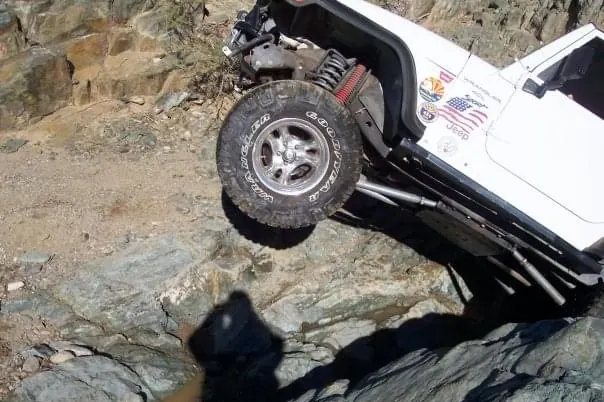
A stock TJ tops out near 31 inches. Quadratec's wheel FAQ gives about 31 inches without a lift, and its tire FAQ says 33s and 35s on a TJ mean adding a lift kit. ExtremeTerrain's placard list shows how small the starting point is: 215/75R15 or 225/75R15 on most Sports, 30x9.50R15 on some, and 245/75R16 on the Rubicon.
| Kit | Listed lift range | Max tire | Wheel requirement |
|---|---|---|---|
| Rough Country 3.25-inch spring and spacer | 3 to 4.5 inches | 33x12.50 | 3.75 inches of backspacing |
| Rough Country 4-inch with lower arms | 3 to 4.5 inches | 33x12.50 | 3.75 inches of backspacing |
| Zone Offroad 3-inch | 3 to 4.5 inches | 33x12.50 | Not stated |
| TeraFlex 4-inch coil base kit | 4 inches | Not stated | 4.5 inches or less |
The TeraFlex 4-inch kit lists more requirements than the rest: adjustable control arms or an adjustable front track bar, caster correction, longer shocks, and a CV-style driveshaft with a slip yoke eliminator. It is also listed as not compatible with Rubicon models, so a Rubicon owner has to check fitment before ordering any of these.
Rough Country's 3.25-inch kit lists a transfer case lowering kit and rear track bar bracket but no front track bar. Its 4-inch kit recommends a slip yoke eliminator and CV rear driveshaft. Quadratec's lift guide says about 2 inches may work without one, and 3 inches or more typically calls for one. A Zone Offroad buyer reported slight driveline vibration at 3 inches and planned the same fix. See the SYE guide.
Rough Country and Zone rate their kits to the wider 33x12.50, but width causes rubbing even when height clears. ExtremeTerrain notes width on a 33 can run from under 10 to over 11 inches, and that it can hit inner fenders, suspension parts, or end links.
The direct owner comparison available comes from CJ owners rather than TJ owners, so treat it as direction only: narrower 10.50s were reported as less likely to rub at full steering lock and lighter on the steering, while one owner reported running 33x12.50s on 8-inch wheels for decades with no problems.
Factory wheels matter here. The TJ uses a 5x4.5-inch (5x114.3mm) bolt pattern on 15-inch wheels, with 16-inch wheels offered on the Rubicon. A 33x10.50R15 or 33x12.50R15 needs a 15-inch wheel, so a Rubicon on factory 16s is looking at a 285/75R16 instead, which works out to about 32.8 inches tall by the arithmetic. The wheel guide covers width and offset.
Fender flares and a body lift are the other tools. ExtremeTerrain notes that trimming or replacing flares can address rubbing, with the front usually the easier end, and that a body lift adds a little clearance for less money than a suspension kit.
ExtremeTerrain lists factory Wrangler ratios of 3.07, 3.55, 3.73 and 4.10, with 4.10 typical on Dana 44 Rubicons. You probably do not need gears for 33s if you already run 4.10s and stay on pavement or mild trails.
ExtremeTerrain's chart at 65 mph in a 1:1 gear puts a 33 at 2,469 rpm on 3.73, 2,720 on 4.11, and 3,018 on 4.56. A 3.07 axle is not on the chart; the same formula gives about 2,030 rpm. Those numbers assume a 1:1 gear. In overdrive, Quadratec says real rpm runs 15 to 30 percent lower, and ExtremeTerrain's highway target is around 2,600 rpm, so 33s on 3.07s or 3.55s end up well under it.
The site's vehicle data calls 4.56 to 4.88 the common range for 33s. If you still have a Dana 35 in the rear, read Dana 35 failures first, and use the regear guide for the process. The speedometer will read wrong after the tire change until it is corrected.
Most TJ owner forums were not reachable while researching this guide. These common claims could not be confirmed from a page we opened, so they are left out of the numbers above and need a check on your Jeep:
- Whether 33s clear at 3 inches with stock flares and no bump stop extensions.
- Steering stop adjustments for tire contact with the sway bar or control arm at full lock.
- Whether a 33 fits the stock spare carrier without a body lift.
- A current price for 33x12.50R15. The range above covers four to five 33x10.50R15 KO2s at $345 each, Quadratec's price when written, with no lift, wheels, or gears.
Steps
- Confirm your trim, wheel diameter, and axle ratio. A Rubicon starts from 16-inch wheels and a different kit list.
- Choose the lift. Check the kit's wheel requirement and its driveshaft note before you order.
- Order 15x8 wheels at the kit's backspacing, usually 3.75 inches for Rough Country.
- Install the lift, including any bump stops, and set the track bars.
- Mount one tire and wheel, and turn lock to lock on the ground. Mark contact points with chalk.
- Compress each corner safely, or use a ramp with a spotter. Trim plastic before metal.
- Tighten the lugs to your owner's manual or wheel maker's number. Recheck after the first drive.
- Test for driveline vibration on the highway, correct the speedometer, and decide on gears.
Why it works
- A 33 is the size the common TJ kit makers rate and publish requirements for.
- Stays well short of the axle and steering work that the 35-inch guide requires.
Trade-offs
- You need a lift and usually new wheels, on top of the tires.
- Lifts of 3 inches or more often bring driveline vibration and SYE costs.
- 33s on 3.07s or 3.55s may send you to a regear.
- Low backspacing pushes the tire outward, so check fender coverage.
Tools required
- floor jack
- jack stands
- torque wrench
- tape measure
- chalk or paint marker
Parts
| Part | Vendor | Est. price |
|---|---|---|
| BFGoodrich All-Terrain T/A KO2 33x10.50R15 (each) | BFGoodrich | ~$345 |
| Rough Country 3.25-inch suspension and spacer lift, N3 shocks | Rough Country | ~$470 |
| Rough Country 4-inch lift with lower control arms, N3 shocks | Rough Country | ~$750 |
| Zone Offroad 3-inch lift with Nitro shocks | Zone Offroad | ~$505 |
Sources
- Rough Country 3.25-inch lift for 97-06 TJ (Quadratec)
- Rough Country 4-inch lift for 97-06 TJ (Quadratec)
- Zone Offroad 3-inch lift for 97-06 TJ (Quadratec)
- TJ 4-inch coil spring base lift kit (TeraFlex)
- Aftermarket Jeep Wheels FAQ (Quadratec)
- Jeep Lift Kits Explained (Quadratec)
- Jeep Tire FAQ (Quadratec)
- When and Why You Should Regear Your Wrangler (ExtremeTerrain)
- How Big Can My Jeep Tires Be Without a Lift Kit? (ExtremeTerrain)
- Ultimate Tire Size Guide for Jeep Wranglers (ExtremeTerrain)
- Gear Ratio and Tire Size Chart (ExtremeTerrain)
- Best Gear Ratio for Larger Jeep Tires (Quadratec)
- 33x10.50R15 vs 33x12.50R15 (Jeep-CJ.com)
- BFGoodrich KO2 size table (Quadratec)
Related
- Running 35" Tires on the TJ — Lift and Fitment Requirements
- Wheel Selection for the TJ — Steel, Alloy, and Beadlock
- Mid-Tier Lift Kit — 3"–4" Spring Lift ($600–$1,500)
- Budget Lift Kit — Coil Spacers and Entry Springs (≤$600)
- Re-Gearing the TJ — 4.56, 4.88, and 5.13 Ratios
- SYE Kit for the NP231 Transfer Case — Eliminating Driveshaft Vibration
- Dana 35 Rear: Known Failures and the Fix
- All Jeep Wrangler TJ guides & tools
- Browse the full DIY database
Related tools
- Lift & Tire Matrix — what tire fits at each lift height, with rubbing notes and gearing
- Wheel Offset & Backspacing Visualizer — see where a wheel sits before you buy it
- Tire Pressure / Airdown — trail pressure for your tire size and terrain
Written and maintained by an AZ wheeler and driveway wrencher. How we source guides. Always cross-reference your factory service manual — modifications affect vehicle safety and warranty. Work at your own risk. Spot an error? Send a correction and it gets fixed at the source.